
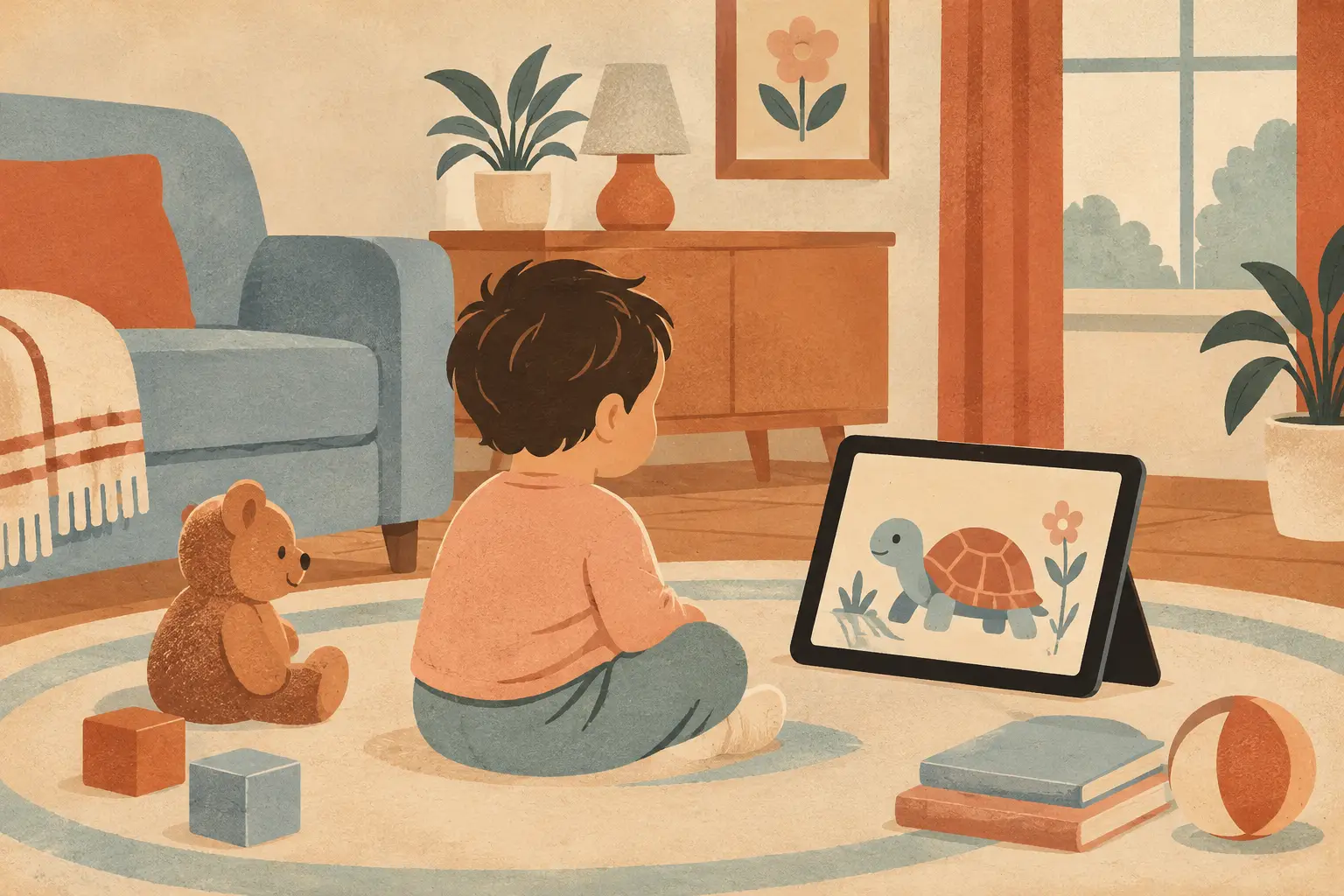
Screen time does not automatically make a 2-year-old’s day go wrong; the harder part is fitting it into real life without letting it take over meals, play, transitions, or the few quiet minutes you need to make dinner.
For screen time for 2 year olds, a useful starting point is the World Health Organization’s published guidance: no more than one hour of sedentary screen time per day, with less being better. But a daily number is only one piece of the picture. What your child watches, whether an adult is nearby, and what the screen replaces all matter too.
What Is Screen Time?
Screen time is time spent looking at and interacting with a screen, including TV, a phone, tablet, video call, or computer. For a 2-year-old, it can range from watching a short show with a parent to tapping through a simple game alone.
Unlike handing over a device whenever a child is restless, intentional screen time lets you choose a moment, an activity, and a clear ending.
Start with the moments that feel hardest
Most families do not need another rule taped to the refrigerator. They need help with the moments when a screen feels like the only workable option: a long call, a sick day, a restaurant wait, a sibling’s appointment, or the last half hour before dinner.
That does not mean every difficult moment needs a video. It means it helps to decide which situations genuinely call for one, rather than reaching for the phone by default. A small, predictable routine can make screen use feel less like a negotiation.
For example, a family might save a short program for while dinner is being finished, rather than turning on videos at random throughout the day. Another might use a video call to help a grandparent stay part of a child’s week. The right pattern depends on your household, your child’s temperament, and what else is happening that day.
The goal is not to make every minute screen-free. It is to leave room for the things that tend to matter most at age 2: talking, moving, noticing, trying things, and spending time with people.
Think about what the screen is replacing
One hour on paper can look very different in practice. A calm show after an active morning is not the same as a tablet that repeatedly interrupts meals, outdoor time, or winding down for bed.
When deciding whether a screen choice works for your family, ask a simple question: what would this time otherwise be? If the answer is a brief wait in a boring lobby, the trade-off may feel reasonable. If the answer is a regular chance to connect, play, or settle into sleep, it may be worth trying another option first.
This is also why guilt is not especially useful. Parenting a 2-year-old involves messy handoffs, interrupted work, and plans that change before breakfast. One video on a difficult afternoon does not define your family’s habits. What matters more is the overall rhythm across a week.
Choose slower, simpler content
At age 2, children often respond best to content that is easy to follow and does not move at a frantic pace. Look for familiar songs, stories, everyday objects, animals, or people doing recognizable activities. If you cannot tell what is happening without watching closely, it may be too busy for a young child.
Ads can make this harder. They interrupt the experience and can quickly pull a child toward unrelated, louder content. If you use a video platform or app, it is worth checking what happens when one episode ends and whether autoplay is switched on.
A smaller choice can also be easier to end. A single short video, one story, or one simple activity gives you a natural stopping point. An endless feed is designed to remove those stopping points, which is not especially helpful when your child is two and transitions are already a big job.
Watch together when you can
Co-viewing does not require narrating every second. Sitting nearby and responding to what your child notices is enough. You might say, “That dog found a ball,” or ask, “Can you spot the red truck?”
Those small exchanges turn passive watching into shared time. They also help you see whether the content is landing well. A child who is laughing, pointing, or repeating a favorite phrase may be engaged in a way that feels different from a child who seems increasingly wound up or upset.
Of course, co-viewing is not always possible. Sometimes you need ten uninterrupted minutes. When that is the case, choosing familiar content and setting it up before you hand over the device can make the moment calmer for both of you.
Make endings easier than beginnings
The end of screen time is often where the real trouble starts. Toddlers do not love surprise transitions, especially when the next activity is less exciting than a bright screen.
Try making the ending visible and predictable. You can say, “One more song, then we wash hands,” or “When this episode is over, we pick a book.” The next step should be simple and ready to go. Asking an overtired 2-year-old to invent a new activity on command is a tough sell.
It can also help to avoid using a screen as the only way to calm down. A screen may work quickly, but having a few other familiar options gives you more flexibility: a snack at the table, looking out the window, a favorite book, water play, music, or a short walk. Not every option will work every time. That is normal.
Keep devices out of the background
A television playing all day can be more disruptive than a short, deliberate viewing session. Even when nobody is actively watching, background sound and motion can compete with conversation and play.
If the TV is mainly there for adult company, consider audio instead. Music, a podcast with headphones, or a quiet radio station can give you something in the background without constantly drawing a toddler’s attention across the room.
Phones deserve their own boundary, too. Young children notice when adults are absorbed in a screen. Nobody needs perfect phone habits, but putting the device down for a few small, reliable parts of the day can help. Meals, a few minutes after pickup, or the bedtime routine are practical places to start.
When screen time feels like it is causing friction
If screens are becoming the center of daily battles, start small. Do not try to redesign the whole household in one Monday morning. Pick one pressure point, such as autoplay, videos during meals, or the device coming into the bedroom.
Then replace that one pattern with something specific. “No more screens” is broad. “We watch one episode in the living room, then the tablet charges on the kitchen counter” is easier to follow. Clear physical cues often work better than repeated reminders.
If you have concerns about your child’s development, behavior, sleep, or a pattern that feels unusually difficult to manage, a pediatrician can help you think through your situation. General guidance is useful, but your family deserves advice that accounts for the full picture.
Frequently Asked Questions
Is one hour of screen time okay for a 2-year-old?
The World Health Organization recommends no more than one hour of sedentary screen time for 2-year-olds, with less being better. That guidance is a starting point, not a reason to ignore context. Consider the content, whether an adult is involved, and what the screen time is displacing.
Does video chatting count as screen time?
Video chatting involves a screen, but it is also a live social interaction with a real person. A call with a grandparent is different from passively watching a stream of videos, especially when your child can talk, wave, and respond.
What should I do when my toddler gets upset after the tablet is turned off?
Keep the ending predictable and offer one clear next activity. A consistent routine, such as one episode followed by a snack or a book, can be easier for a toddler to understand than changing the rules from day to day.
A Tool Worth Trying
If you’re looking for a calm, offline activity for a child ages 2 to 5, Tortie’s Garden is a simple learning game with no ads, no purchases, and no data collected. It is coming soon for iPhone and iPad, and is designed for the kind of short, intentional play that fits around everyday family life.
Related reading
- How to Create a Calmer Toddler Bedtime Routine
- Simple Ways to Keep Toddlers Busy While Dinner Cooks
- What to Look for in an Ad-Free Toddler App
- How to Build Small, Repeatable Family Routines
The most sustainable screen plan is usually the one you can repeat on an ordinary Tuesday, one snack, one transition, and one nap time at a time.