

Your baby finally has a good nap, and then the next day they refuse the same nap at the same time. That is not a sign you are doing it wrong. A baby sleep schedule guide is most useful when it gives you a rhythm to follow, not a minute-by-minute rulebook to defend.
Babies change quickly, especially in the first year. Feeding needs, developmental leaps, illness, travel, and a missed nap can all reshape the day. The goal is a predictable pattern that makes sleep easier for your baby and planning easier for you, one nap time at a time.
Quick answer: In the first year, a baby sleep schedule moves from feed, sleep, repeat in the newborn weeks to about three or four naps by 3 to 6 months and two naps by 9 to 12 months, with awake time slowly growing from under 90 minutes to a few hours. Treat these as loose ranges, watch your baby’s sleepy cues, and always follow safe sleep basics.
This guide is general information, not medical advice. Every baby is different, so ask your pediatrician or health visitor about your own baby.
Why start with a rhythm instead of a rigid clock?
For young babies, sleep is driven more by hunger and short periods of alertness than by a fixed schedule. As babies get older, their body clock becomes more reliable and bedtime settles into a familiar range. Forcing a 9:00 a.m. nap because a chart says so can create more stress than it solves.
Instead, watch two things together: when your baby last woke up and how they are acting now. A baby who turns away, gets quiet, rubs their eyes, stares into space, or becomes suddenly fussy may be ready to sleep. Those signs can show up before a full meltdown.
Wake windows are a helpful planning tool, but they are ranges, not deadlines. Some babies need a little more awake time to build sleep pressure; others get overtired quickly. After a long nap, the next window may look different than it did after a 25-minute catnap. That is normal. If you want to see your own baby’s rhythm, start by learning how to track a baby sleep schedule for a few days.
What does a baby sleep schedule look like by age?
Every baby is different, so use these ranges as a starting point. They are commonly cited patterns, not medical targets. Premature babies may follow an adjusted-age timeline, and feeding or health concerns can change the plan. If you have concerns about your baby’s growth, breathing, reflux, or sleep safety, talk with their pediatrician.
| Age | Typical naps | Typical awake time | What to focus on |
|---|---|---|---|
| Newborn to 3 months | Many short sleeps, day and night | About 45 to 90 minutes | Feeding, daylight by day, calm and dim nights |
| 3 to 6 months | Often 3 to 4 | About 1.5 to 2.5 hours | Steady morning wake time, short wind-down |
| 6 to 9 months | Often 2 to 3 | About 2 to 3.5 hours | Moving toward two naps when ready |
| 9 to 12 months | Usually 2 | About 3 to 4 hours | Protecting the two-nap routine |
For a deeper look at how naps change, see our baby nap patterns guide for the first year.
Newborn to 3 months: feed, sleep, repeat
Newborn days rarely run on a dependable clock. Many newborns sleep a large share of the day, often cited as around 14 to 17 hours in total, with frequent waking to feed. Awake stretches are often short, and night feeds are expected.
A simple day might move through feeding, a short awake period, then sleep, repeated several times. Focus on daylight during daytime feeds and keep nighttime care calm and dim. You do not need a perfect routine here. You are helping your baby learn that daytime is active and nighttime is quiet. The NHS has gentle tips on helping your baby to sleep in these early weeks.
It helps to track feedings, naps, and diapers for a few days. The pattern is often easier to see in a simple log than in the blur of a tired afternoon, and a shared log makes the handoff between caregivers less dependent on memory.
3 to 6 months: a loose daily shape
Around this stage, many babies begin to have a more recognizable bedtime and may take three or four naps. Awake time often falls around 1.5 to 2.5 hours, though the first window of the day is commonly shorter.
You might see a day that starts around 7:00 a.m., includes naps in the morning and early afternoon, and ends with bedtime around 7:00 or 8:00 p.m. The exact times matter less than the order. Protect a consistent morning wake time and a familiar wind-down before bed.
If naps are short, resist the urge to stretch your baby too far before the next one. Short naps are common while sleep cycles are still maturing. An earlier bedtime can be a better fix than pushing through to a later one.
6 to 9 months: more predictability, usually fewer naps
Many babies shift toward two or three naps during this window, and awake periods often lengthen to roughly 2 to 3.5 hours. A two-nap rhythm may emerge toward the later part of this range, but not every baby is ready at the same time.
A sample two-nap day could look like a 7:00 a.m. wake, a late-morning nap, an early-afternoon nap, and bedtime around 7:00 p.m. If the second nap ends late, bedtime may move later too. On a day with poor naps, a brief third nap or an early bedtime may keep everyone out of the overtired zone.
This is also an age when separation anxiety and new skills can interrupt sleep. Crawling practice, pulling up, and a stronger awareness that you left the room are big changes for a small person. Keep your response steady and your routine boring in the best possible way.
9 to 12 months: protect the two-nap routine
Most babies in this range do well with two naps and wake windows around 3 to 4 hours. Bedtime is often more stable now, but sleep can still wobble when teeth, travel, illness, or developmental changes show up. If you are wondering when the long stretches arrive, our realistic timeline on when babies sleep longer can help set expectations.
A common mistake is dropping to one nap too early because the second nap becomes difficult. Before making that change, consider whether the first nap is too long or too early, or whether your baby simply needs a little more awake time before nap two. Many babies are not ready for one nap until after their first birthday.
Keep the final wake window comfortable enough for bedtime. If bedtime becomes a long struggle night after night, the day’s sleep timing may need a small adjustment. It does not mean your whole routine has failed.
How do you build a bedtime routine that is easy to repeat?
A bedtime routine works because it gives your baby familiar cues, not because it needs ten carefully chosen steps. Choose a short sequence you can do even on a hard day: diaper, pajamas, feeding, a book or song, then bed. Keep lights low and voices calm. For more ideas, read how to build bedtime routines that actually stick.
Feeding can absolutely be part of the routine. If you eventually want your baby to fall asleep without feeding, you can gradually move the feed earlier in the sequence. There is no prize for changing it before your family is ready.
Consistency matters more than perfection. A grandparent visit, a late car nap, or a skipped bath will not erase your progress. Return to the usual cues at the next sleep opportunity.
What should you do when the schedule falls apart?
It will. The useful question is not, “How do we prevent every bad nap?” It is, “What is the smallest adjustment that helps today?”
After a missed nap, offer the next sleep a little earlier rather than holding the original schedule. After a very late nap, shorten it if needed to preserve bedtime, depending on your baby’s age and mood. During illness, prioritize comfort, feeding, and rest over routine, then ease back into the old rhythm once your baby feels better.
Avoid changing several things at once. If you alter wake windows, bedtime, nap length, and the sleep environment in one week, it becomes hard to tell what helped. Make one small change for a few days, then reassess.
Why keep sleep safety separate from sleep strategy?
Schedules can be flexible. Safe sleep practices should not be. Put babies to sleep on their backs on a firm, flat sleep surface designed for infant sleep, with a fitted sheet and no loose blankets, pillows, toys, or positioners. Room-sharing can make nighttime care easier in the early months, while bed-sharing carries risks worth discussing with your pediatrician. The American Academy of Pediatrics explains these basics in its parent’s guide to safe sleep.
If your baby falls asleep in a car seat, stroller, swing, or other sitting device, move them to an appropriate flat sleep surface when you can. Advice online can be noisy, so when safety guidance conflicts, lean on your child’s medical team.
A workable schedule is not the one that looks best in a screenshot. It is the one that helps your baby get enough rest, gives your household a little breathing room, and can bend when real life happens.
How FeedRight helps
FeedRight Baby Tracker makes the pattern easier to see without turning sleep into a spreadsheet. If you are curious how tracking fits into a real day, here is how a baby sleep tracker app eases your routine.
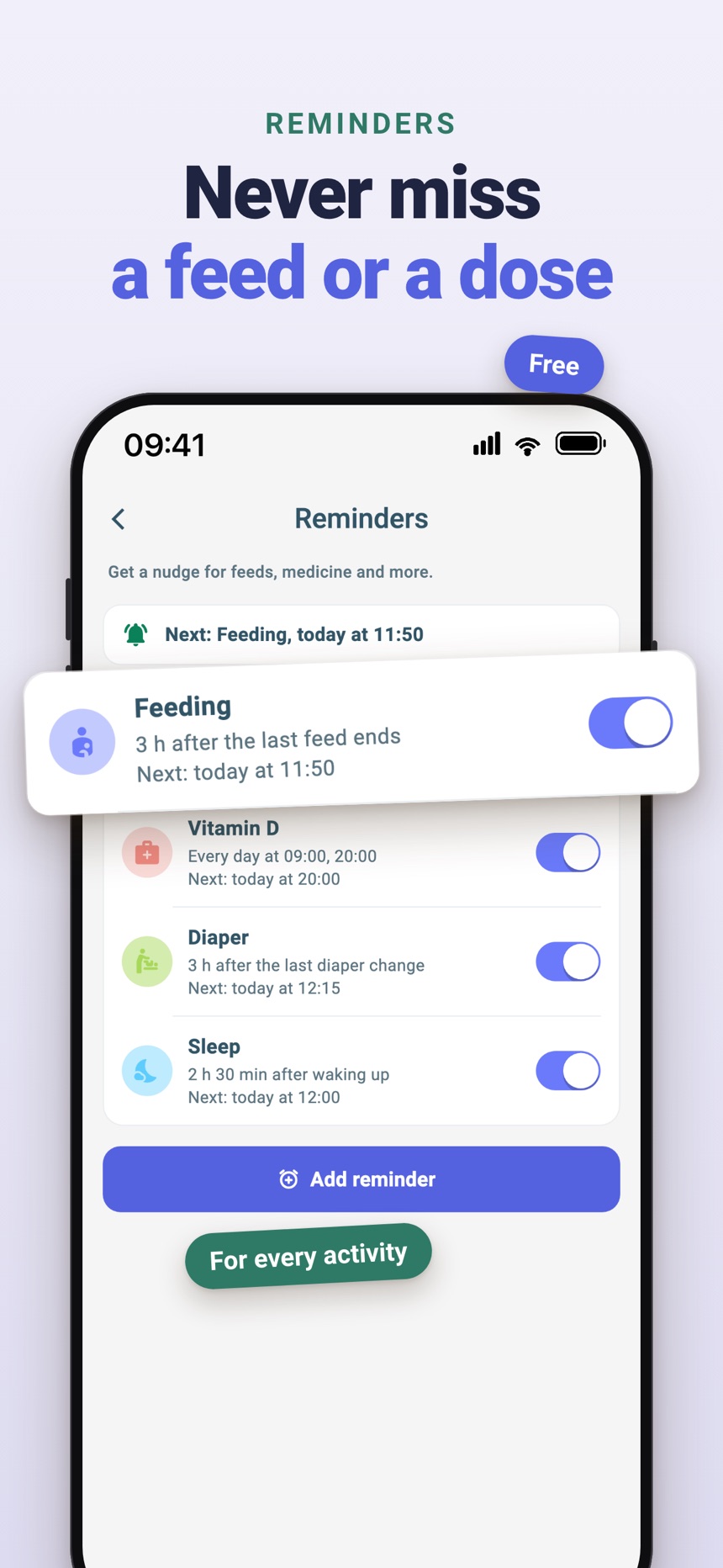
- Start and end a sleep in one tap, including from the Lock Screen and Dynamic Island on iPhone.
- From 3 months of age, the Sleep Time card estimates when the next nap is due.
- Log feeds and diapers in the same place; FeedRight Premium, an optional subscription, adds a daily sleep score and 7 and 28 day statistics.
FeedRight is free on the App Store and Google Play. It is not a medical device, so bring sleep worries to your pediatrician.
Frequently asked questions
How many naps does a baby need in the first year?
It changes with age. Newborns sleep in many short stretches, many babies take three or four naps around 3 to 6 months, and most settle into two naps by 9 to 12 months. Your pediatrician can tell you what fits your baby.
What are wake windows for babies?
Wake windows are the stretches of awake time between sleeps. They grow from under 90 minutes in the newborn weeks to a few hours near the first birthday, but they are ranges to watch alongside sleepy cues, not strict deadlines.
What time should a baby go to bed?
Many babies settle into a bedtime somewhere around 7:00 to 8:00 p.m. once a daily rhythm forms, often after 3 months. The right time depends on your baby’s last nap and your family’s day.
When do babies switch to one nap?
Many babies are not ready for one nap until after their first birthday. If the second nap gets hard before then, try adjusting the first nap or the awake time before dropping a nap.
Is it safe for my baby to nap in a car seat or swing?
If your baby falls asleep in a car seat, stroller, or swing, move them to a firm, flat sleep surface when you can. Babies should sleep on their backs with no loose blankets, pillows, or toys.
What is a typical nap schedule for a 1 year old?
Most 1 year olds take two naps a day, often one in the late morning and one in the early afternoon, with about 3 to 4 hours of awake time between sleeps. Many babies are not ready for a single nap until after their first birthday, so treat this as a loose range.