

Those first few days home can feel like one long loop of feeding, burping, changing, and trying to remember what happened last. A newborn feeding and diaper schedule helps, but not because babies follow a perfect clock. It helps because patterns start to show up, and once you can see them, the day feels a little less chaotic.
The biggest mindset shift is this: with a newborn, you are usually tracking rhythms, not running a strict timetable. Some babies want to eat every two hours like clockwork. Others bunch feeds together, then sleep a little longer. Diapers can be just as uneven. What matters most is whether your baby is feeding often enough, making the expected number of wet and dirty diapers, and acting generally satisfied between feeds.
Quick answer: Most newborns feed about 8 to 12 times in 24 hours, often every 2 to 3 hours, with uneven gaps and evening cluster feeds. Wet diapers increase over the first days, and after the first week many babies have 6 or more wet diapers a day. Think in a repeating loop of feed, change and sleep, and ask your pediatrician what is right for your baby.
This guide is general information, not medical advice. Every baby is different, so ask your pediatrician or health visitor about your own baby.
What does a newborn feeding and diaper schedule really look like?
Most newborns eat 8 to 12 times in 24 hours. That often works out to feeding every 2 to 3 hours, but there is plenty of variation. Breastfed babies may feed more often because breast milk digests quickly. Formula-fed babies may sometimes go a bit longer between feeds. Neither pattern is automatically better. The American Academy of Pediatrics explains how often and how much babies eat by age, and our guide on how often newborns should feed covers hunger cues in more depth.
Diapers are one of the easiest ways to tell whether feeding is going well. In the early days, output changes fast. On day one, you may see only one wet diaper and one dark, sticky meconium stool. By day three or four, wet diapers should increase, and stools change from dark to greenish, then yellowish. After the first week, many newborns have at least 6 wet diapers a day. Stool patterns vary more, especially between breastfed and formula-fed babies. The NHS guide to the first few days of breastfeeding describes these changes clearly.
So a newborn schedule is less about fixed times and more about a repeating cycle: feed, burp, change, settle, rest, then start again. When you expect a loop instead of a clean hourly plan, life gets easier.
What is normal for feeds and diapers by age?
These ranges are typical, not targets. Your pediatrician may give you different numbers for your baby, especially if there are concerns about weight gain or jaundice.
| Age | Feeds | Wet diapers | Stools |
|---|---|---|---|
| Days 1 to 5 | Often every 2 to 3 hours; some sleepy babies need waking | Start low and rise, often about one per day of life | Meconium first, then changing color |
| Week 1 to 4 | 8 to 12 in 24 hours, often clustered in the evening | 6 or more a day is common | Varies widely; breastfed stools often loose and seedy |
| 1 to 2 months | Some babies start spacing feeds a little | Stay regular | May become less frequent for some breastfed babies |
Days 1 to 5
In the first few days, feeding can feel constant, especially if you are breastfeeding and milk is still coming in. Many newborns are sleepy and may need to be woken for feeds; pediatricians commonly recommend feeding at least every 2 to 3 hours in this stage, especially until weight gain is on track.
Diapers start slowly. A rough rule many parents hear is one wet diaper for each day of life during the first few days. It is not the whole story, but it can be a useful shorthand. Sample timing might look like a feed at 6:00 a.m., another around 8:30, another near 11:00, but expect uneven gaps. Newborns do not read schedules.
Week 1 to week 4
Once feeding is established, many babies settle into 8 to 12 feeds in 24 hours. Some feed every 2 hours during the day and stretch to 3 hours at night. Others cluster feed heavily in the evening.
Wet diapers usually become more predictable now. Some babies poop after every feeding; others a few times a day. Breastfed babies often have loose, seedy stools, while formula-fed babies may have firmer stools and fewer bowel movements. Our newborn diaper output chart lays out the first weeks day by day.
If your baby seems hungry sooner than expected, feed sooner. Hunger cues matter more than the clock: rooting, sucking on hands, lip smacking and stirring from sleep all count. Crying is usually a later cue.
One to two months
Around this point, some babies show more obvious patterns. Feeds may land around similar times each day, and diaper output gets easier to predict. But this is still not a strict routine season for most families.
Some babies keep eating every 2 to 3 hours. Others begin spacing some feeds a bit more. Dirty diapers may become less frequent for some breastfed babies, even while wet diapers stay regular. If output suddenly drops, your baby seems lethargic, or feeds become very difficult, check in with your pediatrician.
How do you build a realistic schedule without forcing one?
A workable newborn feeding and diaper schedule starts with observation. Pick one or two days and simply note when your baby eats and when diapers happen. Do not try to fix the pattern yet. Just watch it.
Usually, you will start seeing anchors. Maybe your baby has a long feed around 7:00 a.m., a fussy cluster from 5:00 to 8:00 p.m., and a solid stretch after midnight. Once you spot those anchors, you can expect the next feed based on the last one and stop guessing whether a diaper should have happened by now.
This is where a basic feeding tracking routine helps. You do not need a giant system, whether app or notebook. You just need a quick way to log a feeding, note a wet or dirty diaper, and move on with your day.
What is normal, and what is not?
The hard part about newborn care is that a lot of normal things look alarming at first. Feeding every hour during a cluster can be normal. So can a sleepy morning followed by a hungry evening. A blowout after a calm day can be normal too.
Still, there are times when a schedule tells you something useful. Call your pediatrician if you notice:
- fewer wet diapers than expected, which can point to poor intake;
- very long gaps between feeds in a tiny newborn, especially before birth weight is regained;
- persistent or forceful vomiting, not just spit-up;
- a baby who is hard to wake for feeds or seems unusually weak at the breast or bottle.
A schedule is not there to make you obsess. It is there to help you notice change.
How do breastfeeding, formula and mixed feeding change the pattern?
Feeding method affects timing, but not always the way people expect. Breastfed babies often feed more frequently, especially during growth spurts and evening clusters. Formula-fed babies may take larger amounts less often, but they still have hungry days and irregular timing. Mixed-fed babies may be the least predictable of all because patterns shift with what they had last.
This is why comparing your baby to somebody else’s routine usually backfires. A friend’s baby may eat every 3 hours and poop twice a day. Yours may eat every 90 minutes in the evening and poop six times before lunch. The better comparison is your baby today versus your baby a few days ago.
What does a normal newborn day look like?
Say your newborn wakes around 6:30 a.m. for a feed and diaper change. Another feed happens around 8:45, with a wet diaper soon after. Around 11:00, there is another full feed, one dirty diaper, then a short nap. The afternoon rolls through with feeds around 1:30 and 4:00. Then evening hits, and the neat spacing falls apart.
From 5:30 to 9:00 p.m., your baby may want to feed every hour or even more often. That can feel like something is wrong when it is often just cluster feeding. After that, your baby might settle for a longer sleep stretch, then wake around midnight, 3:00 a.m. and 5:30 a.m. Add diaper changes throughout, and that is a very normal newborn day.
Notice what this sample does not do. It does not promise a clean routine. It gives you a shape to expect.
How can you make the schedule easier on yourself?
Keep the goal small. You need enough information to answer a few basic questions: When did the baby last eat? How many wet diapers today? When was the last poop? That is usually enough to reduce stress and make handoffs smoother.
It also helps to think in 24-hour totals instead of one perfect day. One afternoon may be messy. One night may be nonstop. If intake and diapers look solid across the full day, that matters more than whether 2:00 p.m. went according to plan.
If your baby has a medical issue, trouble gaining weight, reflux concerns or feeding challenges, your pediatrician may want more structured tracking. For many healthy newborns, simple consistency is enough.
How FeedRight helps
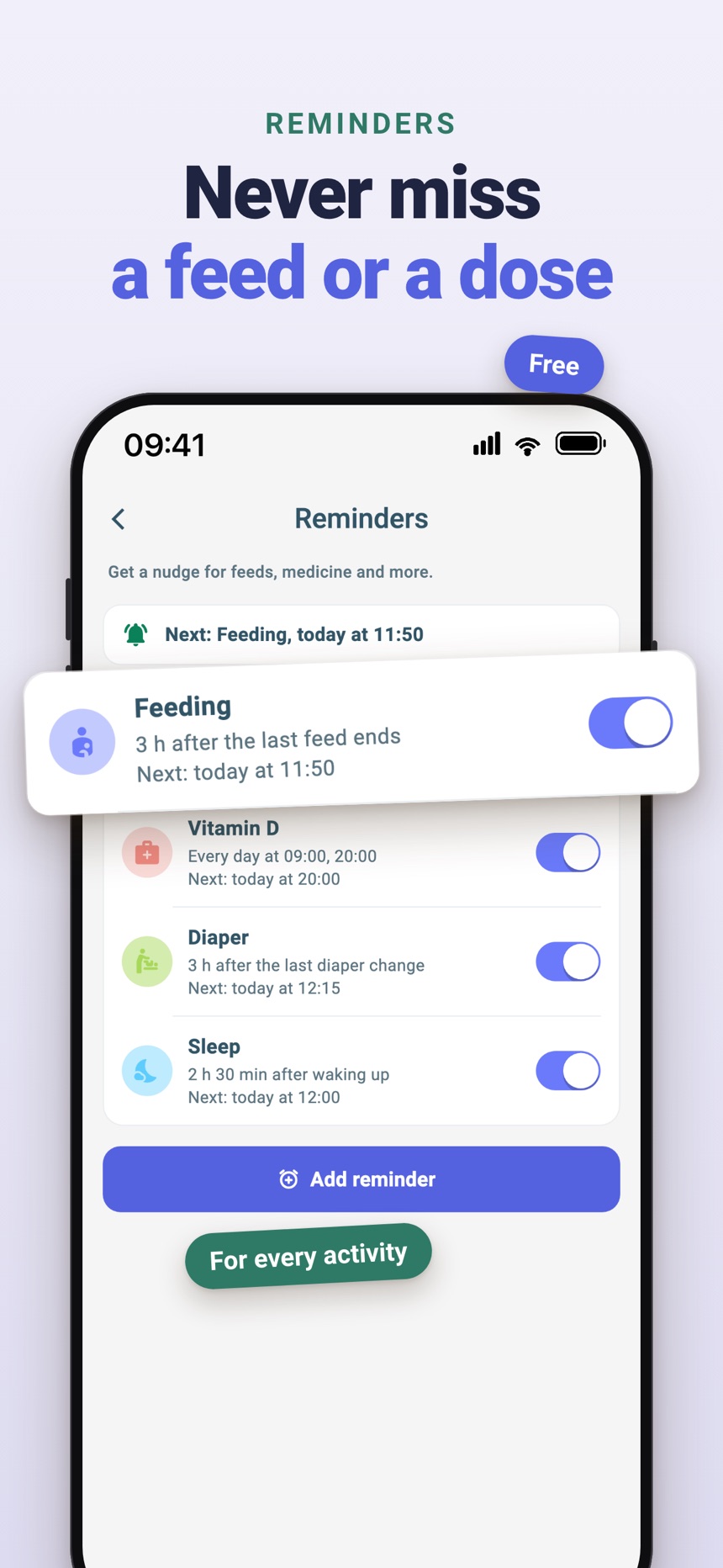
FeedRight Baby Tracker answers those basic questions at a glance. It logs feeds, sleep and diapers (wet, dirty or both) in one tap on iPhone and Android, shows how long ago your baby last ate, and has a daily summary of the day’s feeds and diapers. Core logging is free, needs no account and works offline. It is a memory aid, not a medical device. You can find it on the App Store or Google Play.
You are not failing if your newborn feeding and diaper schedule looks more like a rhythm than a routine. That is how this stage works for most families.
Frequently asked questions
How often should a newborn eat?
Most newborns feed about 8 to 12 times in 24 hours, often every 2 to 3 hours, with uneven gaps. Follow your baby’s hunger cues and your pediatrician’s advice.
How many wet diapers should a newborn have?
Wet diapers start low in the first days and increase. After the first week, many newborns have 6 or more wet diapers a day. Call your pediatrician if wet diapers drop noticeably.
Should a newborn be on a feeding schedule?
Most healthy newborns do better with feeding on cue than a strict clock. Your pediatrician may recommend timed feeds if your baby is sleepy, jaundiced or not yet gaining well.
Is it normal for a newborn to feed every hour in the evening?
Yes, many newborns cluster feed in the evening, sometimes every hour for a few hours, and then sleep a longer stretch. If feeds seem constant all day, check with your pediatrician.
How many diaper changes per day does a newborn need?
Many parents change a newborn’s diaper around each feed, since newborns feed 8 to 12 times a day and often pee or poop after eating. Change any dirty diaper promptly, and ask your pediatrician what wet and dirty diaper counts to expect.
Should I change my newborn’s diaper before or after a feed?
Either can work. Changing before a feed can help wake a sleepy baby to eat, while changing after catches the poop that often follows a feed; many parents change before or midway through so the baby can fall asleep after eating.