
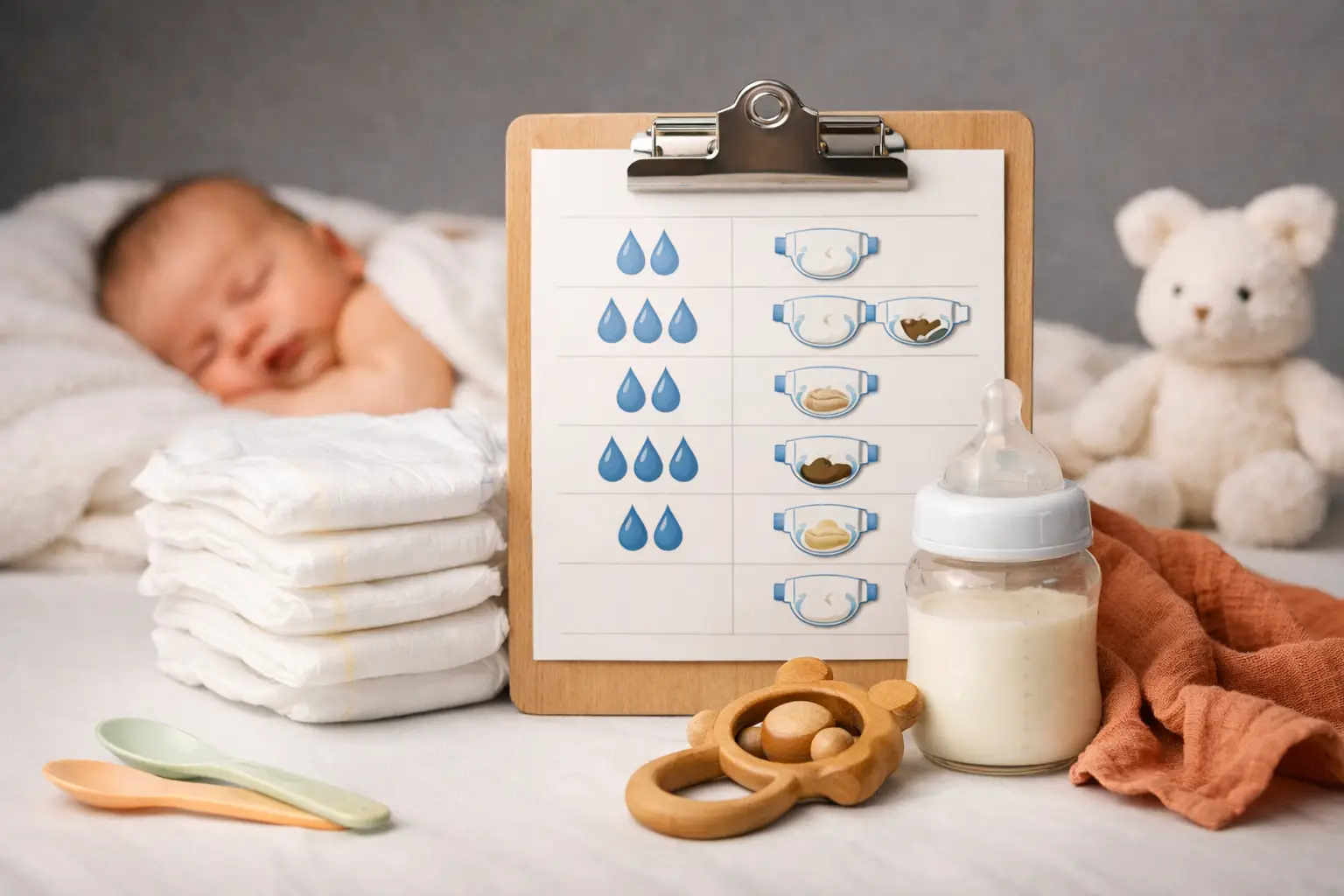
Those first few days at home can make a diaper feel like a tiny medical report. Is that wet enough? Is that color normal? Why has there been no poop since breakfast? A newborn diaper output chart gives you a simple way to notice patterns without trying to memorize every detail while running on very little sleep.
Diapers do not tell the whole story about a baby’s health or feeding, but they are one of the most useful everyday clues. Your baby’s age, whether they breastfeed or take formula, and how feeding is going all affect what you see. Use the chart below as a practical baseline, then bring any concerns to your pediatrician or other baby clinician.
Quick answer: A common rule of thumb is about one wet diaper per day of life in the first days (one on day 1, two on day 2, and so on), rising to around six or more wet diapers every 24 hours from about day 5. Stools change from black meconium to yellow by the end of the first week. Check with your pediatrician about what is right for your baby.
This guide is general information, not medical advice. Every baby is different, so ask your pediatrician or health visitor about your own baby.
What does a newborn diaper output chart look like by day?
These are typical minimums widely shared in newborn guidance, such as the NHS overview of breastfeeding in the first few days. Your hospital, midwife, or pediatrician may give you slightly different numbers, and theirs come first.
| Baby’s age | Wet diapers | Dirty diapers | What you may see |
|---|---|---|---|
| Day 1 | At least 1 | Usually 1 or more | Dark, sticky black-green meconium |
| Day 2 | At least 2 | Usually 1 or more | Meconium may still be present; urine can look concentrated |
| Day 3 | At least 3 | Often 2 or more | Stool begins changing from dark green-black to lighter green or brown |
| Day 4 | At least 4 | Often 3 or more | Stools often become looser and lighter as milk intake increases |
| Day 5 and after | About 6 or more every 24 hours | Often 3 or more for breastfed babies; formula-fed babies vary | Pale yellow urine; yellow, loose, seedy stool is common with breastfeeding |
Think of the wet-diaper numbers as a minimum, not a target to obsess over. Some babies will have more. The big change many parents notice is around day 4 or 5, when feeding is becoming more established and diapers become noticeably wetter and more frequent. For what to expect after the first week, see our age-by-age guide to how many wet diapers a day is normal.
For a newborn, a truly wet disposable diaper can be surprisingly easy to miss. It may feel heavier, squishier, or fuller than a dry one. If you are unsure, pour a few tablespoons of water into a clean diaper to get a feel for the weight. With cloth diapers, the dampness is often easier to spot, but changing frequency and absorbency make comparisons less exact.
What do newborn poop colors usually mean?
Newborn stool changes quickly because your baby’s digestive system is moving from pregnancy to milk feeding. Meconium in the first day or two is normal. It is thick, sticky, and often so dark that it looks black or deep green.
As feeding picks up, stools usually shift through greenish-brown or olive shades before becoming mustard yellow. Breastfed baby poop is often loose, yellow, and dotted with small seed-like bits. Formula-fed baby poop may be tan, yellow-brown, greenish, or a little thicker, like peanut butter or soft paste.
A single green stool is usually not a reason to panic. Stool color can shift with digestion, formula changes, swallowed air, and ordinary day-to-day variation. What matters more is how your baby is acting, feeding, and growing.
A few colors are worth calling about promptly. White or chalky gray stool can point to a problem with bile flow. Red or bloody stool needs medical guidance, even if your baby seems comfortable. After the meconium stage has passed, black stool should also be checked. If your baby has very watery, frequent diarrhea, especially with poor feeding or fewer wet diapers, call the clinician the same day.
Why are wet diapers a helpful feeding clue?
In the early weeks, diaper output offers reassurance that milk or formula is moving through your baby. The pattern matters more than one missed diaper during a long nap. A baby who is feeding regularly, seems satisfied after many feeds, wakes for feeding, and has steadily increasing wet diapers is generally giving encouraging signs.
Still, diapers cannot confirm everything. A baby can have wet diapers and still need feeding support, particularly if weight gain is slow, nursing is painful, or feeds are unusually long and exhausting. That is why newborn follow-up visits and weight checks matter. They fill in the parts a diaper log cannot show. Our newborn feeding and diaper schedule basics explain how the two fit together.
You may see a small amount of pink, orange, or brick-colored staining in the diaper during the first few days. These are often urate crystals, which can happen when urine is concentrated early on. They should fade as intake increases. If they continue after the first few days, or appear alongside fewer wet diapers, call your baby’s clinician.
How does stool frequency change after the first weeks?
During the first month, many breastfed newborns poop several times a day, often right after a feed. That can be completely normal. So can a baby who poops less often later, especially after about 3 to 6 weeks, as long as the stool stays soft and the baby is feeding and gaining well.
Formula-fed babies often poop less frequently than breastfed babies, but there is a wide normal range. Some go once a day; some skip a day. Constipation is not simply about going less often. Hard, dry pellets, obvious discomfort, a swollen belly, or blood from straining are better reasons to ask for advice.
Do not be surprised if your baby grunts, turns red, or looks deeply serious before pooping. Newborns are still learning to coordinate their belly muscles and pelvic floor. If the poop is soft, those dramatic faces are usually just part of the learning curve.
When should you call your baby’s clinician?
Trust your instincts, especially in the newborn period. Call your pediatrician, nurse line, or other clinician if your baby has fewer wet diapers than expected for their age, suddenly has much less output than usual, or is difficult to wake for feeds.
Seek prompt guidance for a dry mouth, no tears when your baby is old enough to make tears, a sunken soft spot, repeated vomiting, fever, persistent urate crystals after the early days, or diarrhea with signs of dehydration. For babies under 3 months, a rectal temperature of 100.4°F (38°C) or higher needs urgent medical attention.
Get help, too, if breastfeeding is painful, your baby is not latching, or you are worried they are not transferring milk. Feeding challenges are common, and early support makes a meaningful difference for both baby and parent. The American Academy of Pediatrics has more on how often and how much babies eat.
How do you keep diaper tracking simple?
You do not need a complicated system. A quick note after each feed and diaper change is enough: time, wet or dirty, and a short description if something looks unusual. Tracking is most useful at appointments, during those first days when output is increasing, or whenever feeding feels uncertain.
A simple app keeps the details in one place when your hands are full. The goal is not a perfect record. It is a clear pattern you can trust, one diaper change at a time.
How FeedRight helps
FeedRight Baby Tracker is designed for quick, everyday logging of feeding, sleep, and diapers, without turning your phone into another project. The free version needs no account and keeps your data on your phone.

- Log a diaper as wet, dirty, or both in one tap, with a note when something looks unusual.
- See today’s diapers next to feeds in the daily summary, handy for checkups.
- Set a diaper check reminder if the days start to blur.
Available on the App Store or Google Play. FeedRight is not a medical device, so always bring concerns to your pediatrician.
Frequently asked questions
How many wet diapers should a newborn have in the first week?
A common guide is about one wet diaper per day of life for the first few days, then around six or more every 24 hours from about day 5. Your pediatrician or midwife may give you numbers specific to your baby.
When does meconium change to yellow poop?
Meconium usually passes in the first day or two, then stools turn greenish-brown and become yellow by around day 4 or 5 as feeding increases. Call your clinician if stools are still black after the first few days.
Are orange or pink crystals in a newborn diaper normal?
In the first few days, pink or orange staining is often urate crystals from concentrated urine. They should fade as your baby takes in more milk. Call your clinician if they continue or come with fewer wet diapers.
What poop colors in a newborn need a call to the doctor?
Call promptly about white or chalky gray stool, red or bloody stool, or black stool after the meconium stage. Very watery, frequent stools with poor feeding or fewer wet diapers also need a same-day call.
How can I tell if a newborn diaper is wet?
A wet disposable diaper feels heavier and squishier than a dry one. Pour a few tablespoons of water into a clean diaper to learn what wet feels like.
How many times a day should a newborn poop?
In the first days, newborns usually have at least one dirty diaper a day, and from about day 4 many breastfed babies poop three or more times a day, often after feeds. Formula-fed babies often poop less, and after about 3 to 6 weeks some breastfed babies go less often too, which can be normal if stools stay soft.