
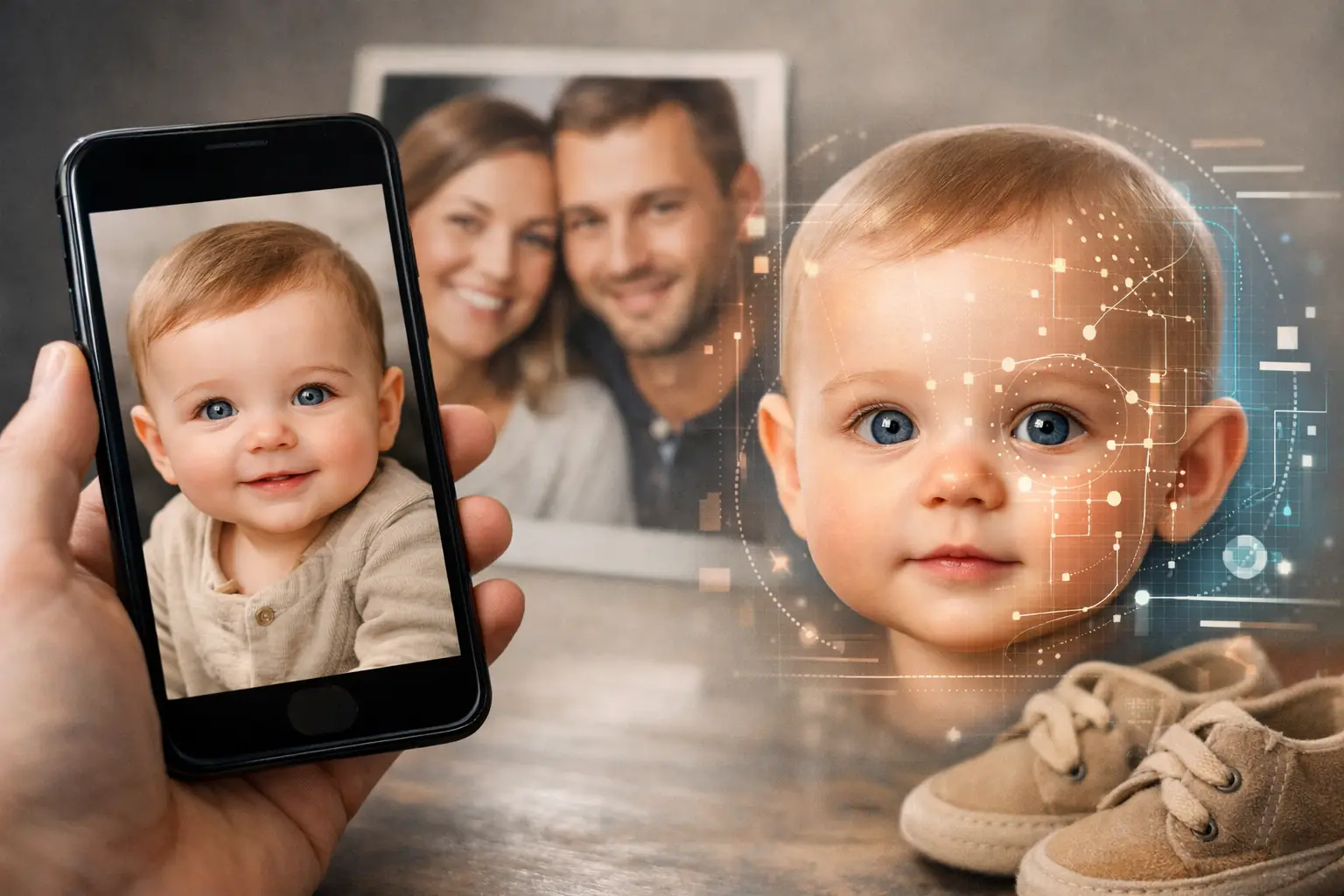
An ai baby face generator is one of those small, joyful uses of technology that can turn a quiet moment on the couch into a conversation. You upload two photos, wait a moment, and see an imagined picture of what a future child could look like. It is fun, a little surprising, and best treated for what it is: a creative prediction, not a family crystal ball.
For couples, it can be a sweet way to daydream. For friends and family, it can make a funny reveal or a lighthearted group chat moment. The best experience comes from knowing what the technology can do, what it cannot know, and how to use your photos thoughtfully.
How an AI baby face generator creates an image
These tools look for visual patterns in the photos you provide, such as face shape, eye placement, hair color, skin tone, and other visible features. The system then creates a new image based on those patterns and the examples it learned from during training. It is generating a believable-looking face, not calculating a genetic outcome.
That distinction matters. A real child inherits a wonderfully unpredictable mix of genes, and some traits may come from grandparents or appear in ways that are not visible in either parent. Hair texture can change as a child grows. Eye color can develop over time. Even siblings with the same parents can look remarkably different.
Think of the result more like a playful visual “what if?” than a preview. It may capture a few familiar features that make you smile, but it cannot predict a real person’s appearance, personality, health, or future.
Better photos usually make a better result
The app can only work with what it sees. Clear, recent photos give it more useful facial detail and tend to produce a more natural-looking generated image. A straight-on photo with good lighting is usually a solid starting point.
Choose an image where each face is fully visible, in focus, and not covered by sunglasses, a hat, hands, or heavy filters. Neutral expressions are often helpful because exaggerated smiles, dramatic angles, and low light can hide important facial details. You do not need professional headshots. A simple, well-lit phone photo works well.
Try to use photos with similar conditions when you can. If one image is bright and close-up while the other is dim and taken from far away, the result may lean too heavily toward one photo. If the first image is not quite right, testing another clear photo is often more useful than expecting one upload to tell the whole story.
A few details can affect the final image more than people expect:
- Large glasses, face-covering hair, and strong beauty filters can confuse visible facial features.
- Old photos may not reflect how someone looks now, especially when appearance has changed over the years.
- Photos with multiple people can make it harder for an app to identify the intended face.
- Images with even lighting usually give the generator a cleaner starting point than photos taken in shadows or harsh sunlight.
Why the result can look familiar but still be wrong
The most memorable part of using an AI baby face generator is often the feeling that the result resembles someone you know. Maybe it has one person’s smile, another person’s cheeks, or an expression that looks a little like a sibling. That feeling is part of the fun, but it can also make the image seem more certain than it is.
AI is especially good at creating faces that feel plausible. It can blend patterns into an image that looks polished and emotionally convincing. But plausible is not the same as accurate. A generated baby may have a feature that neither parent expected, miss a feature that runs strongly in the family, or simply look different each time the tool is used.
This is why it helps to keep the stakes low. Use it as a shared curiosity, not as a way to settle debates about whose eyes a future baby will have. The real answer is one you only get to meet in time.
Privacy deserves a quick pause
Face photos are personal. Before using any app that analyzes or generates faces, take a minute to understand how it handles uploaded images. Look for clear, plain-language information about whether photos are stored, how long they are kept, and whether you can request deletion.
Only upload photos you have the right to use. If you are making a future-baby image with a partner, ask first. That may sound obvious, but a photo can feel more personal than people realize, especially when it becomes part of a generated image that might be shared with others.
It is also worth thinking about where the final image goes. A private laugh between two people is different from posting a generated child image publicly. If you share it, keep the caption honest and make it clear that it is an AI creation. That keeps the moment fun without inviting confusion.
At Digital Traffic Labs, we like focused tools that are easy to understand and easy to use. That includes giving people room to enjoy a playful AI experience without pretending it is more scientific than it is.
A simple way to use it well
Start with a clear photo of each person, then generate an image with curiosity instead of expectations. Look at it together. Notice the features that feel familiar, laugh about the ones that do not, and remember that every result is one creative interpretation.
If you try more than one image, you may see different outcomes. That is normal. It is also a useful reminder that the app is not revealing one hidden truth. It is creating possibilities from the photos and the model behind it.
There are plenty of good reasons to use a future baby generator: celebrating an engagement, making a sweet date-night moment, adding a little fun to a family conversation, or simply satisfying a passing curiosity. The best reason is the simplest one – it gives you a reason to imagine, smile, and talk about the family you are building.
What the image cannot tell you
A generated face cannot tell you whether a child will be healthy, how tall they will grow, what interests they will have, or whether they will inherit your love of pancakes, baseball, books, or sleeping late on Saturday. It cannot account for the full complexity of genetics, environment, and the many tiny surprises that make each child their own person.
That limitation is not a flaw in the experience. It is the point where a little perspective keeps the experience warm. The image is a playful sketch, while real family life is full of details no app could predict: first laughs, stubborn opinions, sleepy car rides, and the routines you learn one day at a time.
Use the generated picture as a moment of fun, then save the bigger wonder for the real person you may someday get to know.