
Most parents-to-be have wondered whose eyes a baby might have, whether they will inherit a parent’s curls, or what a future family photo could look like. That curiosity is real, and it is why the question “can AI predict baby appearance” keeps coming up. The tricky part is separating a fun visual guess from a genuine prediction about a real child.
Quick answer: No. AI can create a plausible, fun image of a possible baby from two parent photos, but it cannot predict how a real child will look. Appearance depends on many genes, how they combine, and chance, and none of that is visible in ordinary photos. Treat any AI baby image as an imagined portrait, not a forecast.
What is AI baby appearance prediction?
AI baby appearance prediction is the use of an image model to blend visual features from photos of two people and generate a fictional portrait of a possible child. It is a creative simulation, not a medical, genetic, or guaranteed forecast.
Why can AI baby images feel so convincing?
A well-made generated baby portrait often looks believable because AI is very good at recognizing visual patterns. It can pick up face shape, eye spacing, hair color, skin tone, and other visible details in the photos it receives. Then it combines those patterns with learned examples of what baby faces commonly look like.
That is different from reading a child’s DNA. The model is not looking at genes, family history, or the many inherited traits that may not show up clearly in either parent’s face. It is producing an image that makes visual sense, not uncovering a hidden photograph of the future.
People also tend to see familiar features in a result, especially when they are emotionally invested. A tiny resemblance to one parent’s smile can make the whole picture feel personal. That connection is part of the fun, but it can also make the output seem more precise than it is. We explain this effect in what an AI baby face generator can show you.
Can AI predict baby appearance from photos?
Not reliably enough to call it a true prediction. A photo-based AI tool can make a reasonable-looking guess from visible traits, but it cannot determine the combination of traits a child will inherit.
Most characteristics are shaped by several genes working together, along with environment, as MedlinePlus Genetics explains in its guide to inherited traits. Some traits skip generations or appear differently in children. Hair can darken or lighten, eye color can develop after birth, and facial features keep changing throughout childhood.
Even ideal inputs would not create certainty. Two photos are only snapshots, influenced by lighting, camera settings, age, makeup, expression, and filters. If the source photos do not clearly show natural features, the generated image has less useful information to work with.
Unlike a genetic test, an AI-generated portrait lets you enjoy a possible family resemblance without treating it as a factual result. That keeps the experience light, which is exactly where it belongs.
What can AI show, and what can it not?
AI can make the abstract question of “what might our baby look like?” feel concrete and shareable. What it cannot do is replace inheritance with a photo editor slider. A baby is not a 50-50 visual blend of two adult selfies, and real children often surprise their families in the best ways.
| An AI baby image can | An AI baby image cannot |
|---|---|
| Blend broad visible features such as face shape, hair shade, and skin tone | Tell you a child’s eye color, hair texture, or height |
| Show one imagined version of a possible child | Show how a real baby will look at birth, six months, or five years |
| Give partners and family a fun conversation starter | Identify inherited health traits or personality |
| Look different each time you try | Account for every relative in a family tree or the chance involved in inheritance |
What shapes a generated result?
The quality of the output depends less on magic and more on the information in the photos. Clear, well-lit portraits usually give an AI model a better starting point than dim group shots or heavily filtered images.
Use photos where each person faces the camera, with their full face visible and no sunglasses, hats, or dramatic shadows. A neutral expression can help, although a natural smile is usually fine. Use recent photos that look like the person in everyday life, not a highly edited social post from years ago. Our photo checklist for future baby apps covers the details.
The model itself matters too. Different tools use different training approaches, settings, and styles. One may create a soft, studio-style portrait, while another leans cartoonish or overly polished. Neither style is evidence that one result is genetically more accurate. If you are weighing options, see AI baby visualizers compared.
How should you use a baby AI generator?
The best use is simple: enjoy it as a playful moment between partners, friends, or family. Think of the output as a conversation starter, like guessing at a family gathering whether a baby will have a grandparent’s nose or an aunt’s dimples.
If you plan to share the image, label it clearly as AI-generated. That prevents relatives from mistaking it for an ultrasound image or a real photo, and it sets the right expectation when someone sees a tiny face that looks uncannily familiar.
There is no need to run dozens of versions chasing the “correct” result. Each generation varies because the tool is creating a new plausible image, not narrowing in on a secret answer. One or two images are often enough.
Why does privacy deserve a quick check?
A face photo is personal data, even when it is a casual selfie. Before uploading images to any AI service, review what it says about storing, processing, and deleting photos.
Avoid uploading photos of people who have not agreed to it, especially children. You may also prefer photos without location details or other identifying information attached. If a tool asks for more access than seems necessary for generating an image, pause and consider whether that trade-off feels worthwhile.
Why will real life still surprise you?
A future-baby image can be sweet, funny, and sometimes moving. But it cannot capture the details that make a child unmistakably themselves: a new expression, a laugh that echoes a relative, or features that emerge slowly over the years. AI can offer a charming possibility, while real life writes the actual story one small milestone at a time. For more on these limits, read what a future baby generator can really show.
How Future Baby AI Generator fits
Future Baby AI Generator is our iPhone app for imagining a possible future family portrait. You add a photo of each parent, choose boy or girl and an age range, and it creates an AI-generated image of an imaginary child in seconds. It is for fun, not a genetic or scientific result, and every image is labeled as AI-generated.
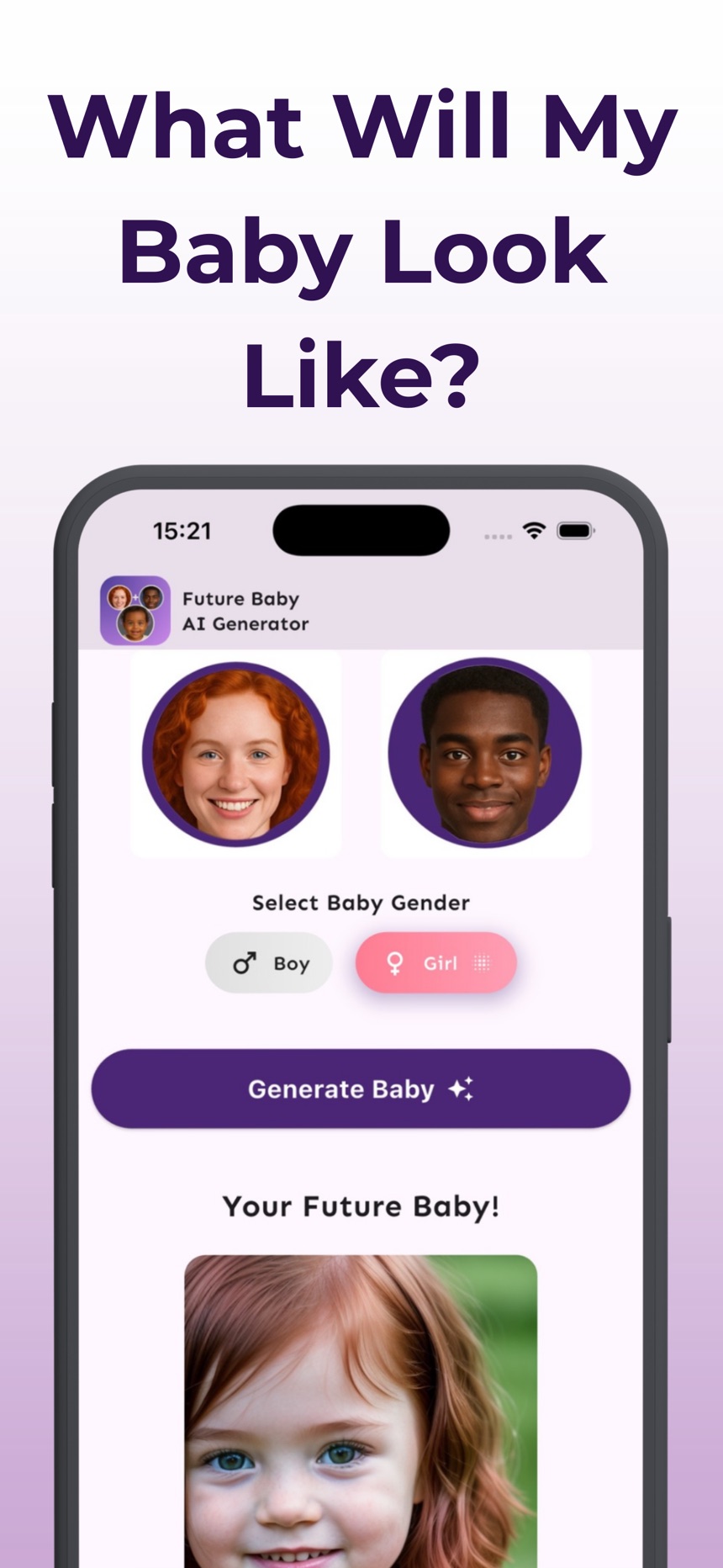
- Photos are used only to create the image and are not stored by the app.
- No sign-up is needed; creating images requires a subscription.
- It works with any two parents, including same-gender couples.
Find out more on the Future Baby AI Generator page or the App Store.
Frequently asked questions
Is an AI baby photo an accurate prediction?
No. It is a realistic-looking visual guess built from visible features in the source photos, not a genetic prediction of a real child.
Can AI tell what color a baby’s eyes or hair will be?
No. AI can suggest a plausible look, but it cannot determine inherited traits such as final eye color or hair color from parent photos. Those traits involve several genes and can change in early childhood.
Do better photos make the result more accurate?
Clear, recent, well-lit photos make the generated portrait look more coherent and more like the people in the images. They do not turn the result into a scientifically reliable forecast.
Why does an AI baby generator give a different face each time?
Each generation is a new image the model creates from the same inputs, not a step toward one hidden answer. Small differences in photos, settings, and the model’s randomness change the result.
What will my baby look like?
No one can know exactly what a baby will look like, because appearance depends on many genes, how they combine, and chance. A baby may resemble one parent, a grandparent or neither, and features, hair and eye color keep changing through early childhood.
Will my child look more like me or my partner?
It is impossible to say in advance: children inherit a mix of traits from both parents, and some traits skip generations or appear in unexpected combinations. Siblings with the same parents can look very different from each other.