

Memory gets unreliable fast when you are trying to recall which side you nursed on last or whether the baby took 1 ounce or 3. That is why learning how to track newborn feedings matters so much in the first few weeks. Not because you need perfect data, but because sleep deprivation makes even basic details slippery.
For most parents, feeding logs are less about creating a spreadsheet life and more about reducing second-guessing. A simple record helps you notice whether your baby is eating often enough, whether feeds are getting shorter or longer, and whether something has changed that might be worth mentioning to your pediatrician. It also makes handoffs easier when two parents, grandparents or a sitter are helping.
Quick answer: To track newborn feedings simply, log three things each time: when the feed started, whether it was breast, bottle or both, and the side or the amount your baby drank. Log right after each feed, use one method that every caregiver shares, and glance back once or twice a day for patterns instead of checking after every entry.
This guide is general information, not medical advice. Every baby is different, so ask your pediatrician or health visitor about your own baby.
Why does tracking feedings help early on?
Newborns eat frequently, and the days can blur together. Tracking gives you a small anchor: you can look back and see when the last feed happened instead of reconstructing the day from fragments.
It also helps you spot patterns that are easy to miss in real time. Maybe your baby cluster feeds every evening. Maybe bottle volumes are slowly increasing. Maybe diaper output drops on a day when feeds were shorter. None of that means you need to obsess over every minute or ounce, but a record makes normal newborn behavior feel a little less mysterious.
There is a practical side too. Pediatricians often ask how often your baby is feeding, for how long, and how many wet and dirty diapers you are seeing. Many newborns feed about 8 to 12 times in 24 hours, according to the American Academy of Pediatrics guide on how often and how much babies eat, and a basic log makes those appointment questions easier to answer.
What should you record when you track newborn feedings?
Keep it simple. The most useful details are usually the start time, whether it was breastfeeding, bottle feeding or a combination, and roughly how much your baby ate if you are using bottles.
For breastfeeding, many parents also track which side they started on and about how long the baby nursed. Duration is helpful, but it is not the whole story. Some babies feed efficiently in a short session, while others take longer. The log gives context, not a grade.
For bottle feeding, note the amount offered and, if possible, the amount finished. What goes into the bottle is not always what goes into the baby. Our guide on how to log bottle feedings covers this in more detail.
If your baby is very young or your pediatrician has asked you to watch intake closely, also track wet and dirty diapers. Feeding and diaper output together tell a clearer story than feeding data alone.
Paper, notes app or baby tracker app?
There is no gold-star method. The best system is the one you will actually use when you are tired, holding a baby, and functioning on one free hand.
| Method | Works well for | Watch out for |
|---|---|---|
| Paper log | Seeing the whole day at a glance, no screen | Easy to lose, hard to share, hard to read at 3 a.m. |
| Notes app | A quick, zero-setup start in the first days | Long lists of timestamps, no time math, hard to spot patterns |
| Baby tracker app | Fast one-tap logging and “time since last feed” | Pick one that stays simple, or you will stop using it |
A paper log suits parents who like seeing everything on one page. A notes app is already on your phone and fine for the first few days, but notes get messy quickly. A dedicated baby tracker app is usually the easiest option if you want consistency: tap the feed, save it, move on. For a deeper comparison, see our baby tracker app vs. notebook guide, and for timers specifically, our post on a feeding timer for newborns.
How detailed should your feeding log be?
Less detailed than you think.
A lot of new parents start tracking with intense precision, then burn out. That is understandable: when everything feels new, more information feels safer. But the goal is enough information to support decisions and reduce stress, not perfect data.
If your baby is healthy, gaining weight and feeding normally, a lightweight log is usually enough: time, method, and amount or duration. If there are concerns about weight gain, latch, milk transfer, reflux or dehydration, your pediatrician may want more detail for a while. Your baby’s health and your doctor’s guidance should shape how closely you track.
The key is to avoid making the log harder than the feeding itself. If logging takes too much effort, consistency drops.
What is a simple routine for tracking newborn feedings?
The easiest routine is to log the feed right when it starts or immediately after it ends. Waiting even 20 minutes can be enough for details to disappear, especially overnight.
If you are breastfeeding, record the time and the side you began on, and add a switch if your baby changes sides. If you are bottle feeding, log the time and amount offered, then update the amount finished when the feed is over.
Once or twice a day, glance back at the log instead of checking it after every entry. That helps you notice patterns without feeding your anxiety. You are looking for broad signals, not tiny fluctuations.
If several adults feed the baby, agree on one method. One parent using a paper notepad while the other keeps notes on their phone sounds manageable until nobody knows which version is current. Our guide on whether parents can share feeding logs walks through setups that work.
Which feeding patterns are actually worth noticing?
Newborn feeding is rarely tidy, so do not expect textbook spacing. Some babies eat every two hours like clockwork. Others bunch feeds together and then take a longer stretch. Both can be normal depending on age, growth and overall health.
What is worth noticing is change. If your baby suddenly feeds much less, seems unusually hard to wake for feeds, has fewer wet diapers, or struggles to finish bottles they usually take well, that matters more than whether one feed was shorter than yesterday’s.
You may also notice time-of-day patterns. Many newborns cluster feed in the evening. That can feel relentless, but seeing it in your log can be oddly reassuring. Hard phases are easier to handle when they look like patterns instead of chaos.
What if tracking starts to feel stressful?
There is a line between useful tracking and anxious tracking, and tired parents can cross it without realizing. If you find yourself checking the log every few minutes, worrying over tiny differences, or feeling like a “bad” parent because one feed was not logged perfectly, the system needs to get lighter.
Try scaling back to the basics for a few days: only time and method, or only feeds and diapers. If your pediatrician is not asking for high-detail records, you do not need them just to prove you are paying attention. Tracking should support your confidence, not replace it.
When should you share your feeding log with a pediatrician?
A feeding log is especially helpful in the newborn stage, after birth weight checks, and any time feeding seems off. If your baby is having trouble gaining weight, seems sleepy during feeds, spits up heavily, or has fewer wet diapers than expected, your record gives the pediatrician something concrete to review.
A log is not a substitute for calling when something feels wrong. If your baby is refusing feeds, seems lethargic, shows signs of dehydration, or you are worried, contact your pediatrician promptly. Tracking is a support tool, not a wait-and-see rule.
How FeedRight helps
We built FeedRight Baby Tracker at Digital Traffic Labs for exactly this everyday need. It logs feeds, sleep and diapers in one tap on iPhone, Apple Watch and Android, and its breastfeeding timer remembers which side you finished on, so you never have to guess when the baby last fed.
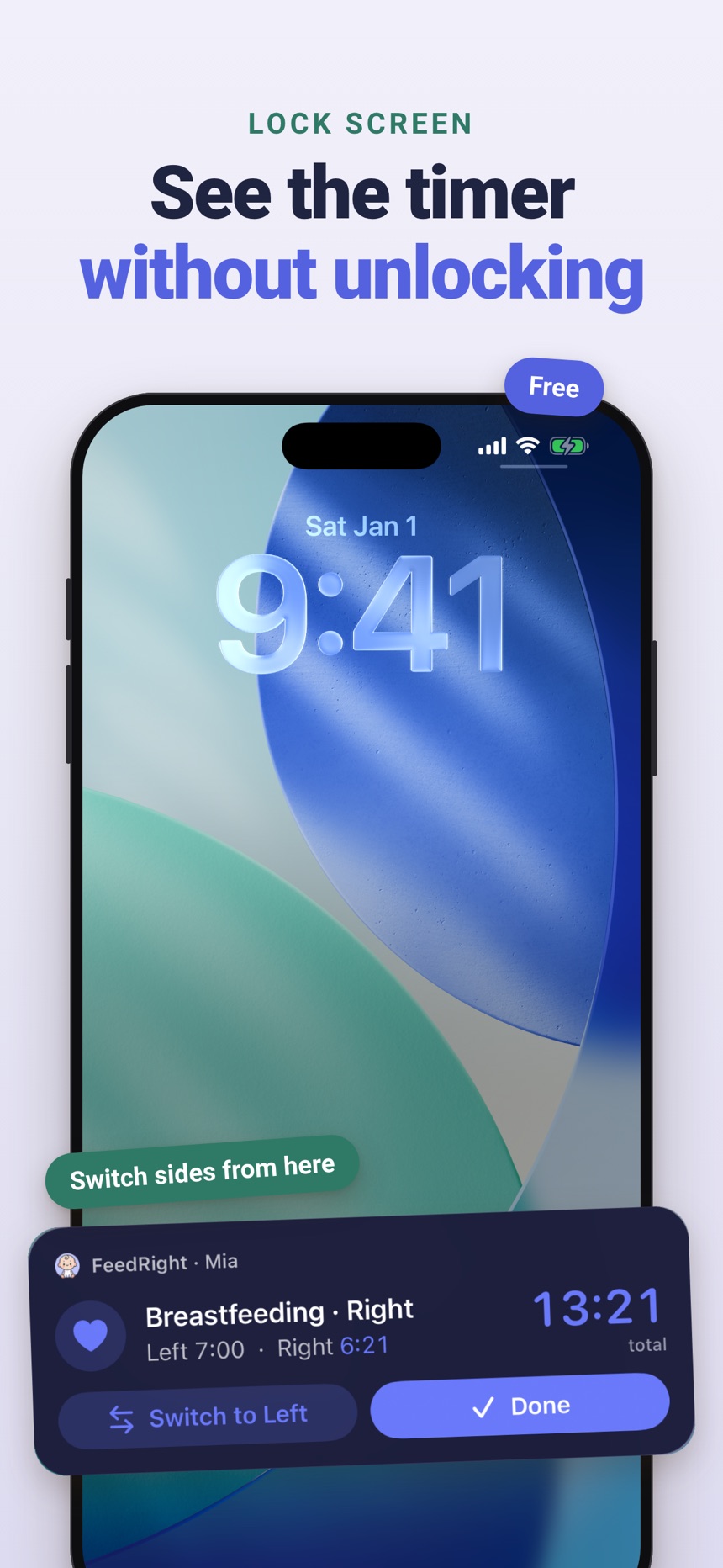
- Free core logging: breastfeeding timer with left and right sides, bottle in ml or fl oz, pumping and diapers, with no account needed.
- A daily summary and history so patterns are easy to see.
- Optional FeedRight Premium adds cloud backup and family sync, so both caregivers see one shared record.
It records what happened; it does not give medical advice. Pick it up on the App Store or Google Play.
Frequently asked questions
What should I write down for each newborn feeding?
The start time, the type of feed (breast, bottle or both), and either the side for breastfeeding or the amount your baby drank from a bottle. Add duration only if it helps you.
How long should I track my newborn’s feedings?
Many parents track closely for the first few weeks, then scale back once feeding and weight gain are going well. Keep tracking longer if your pediatrician asks you to.
Is it better to track feedings on paper or in an app?
Both work if you keep using them. Paper is screen-free and easy to read at a glance, while an app is faster one-handed, does the time math and is easier to share.
Should I track diapers along with feedings?
In the early weeks, yes, if you can. Wet and dirty diaper counts help show whether feeding is going well, and pediatricians often ask about them.
What is a baby feeding record?
A baby feeding record is a simple log of when each feed started, whether it was breast or bottle, and the side or amount. Parents use it to see when the baby last ate and to show a pediatrician how often the baby feeds.
Can one tracker log both feedings and diapers?
Yes. A baby tracker app, or a paper log with two columns, can keep feeds and diapers in one timeline, which makes it easier to see whether feeding and diaper output line up. FeedRight, for example, logs feeds, sleep and diapers in one tap.