
The hard part is not caring about every feed, diaper, nap, and fussy stretch. It is trying to remember the details when you are tired, switching shifts with a partner, and answering a pediatrician’s questions from memory. A newborn care log guide gives those small moments one dependable place to land, so your day feels less like a blur.
Quick answer: A newborn care log is a simple, consistent record of feeds, diaper changes, sleep, and short notes. Log each event right after it happens, keep entries brief, and review the log only when it helps with a handoff or a pediatrician visit. It is a low-pressure memory aid for the early weeks, not a scorecard or a medical tool.
This guide is general information, not medical advice. Every baby is different, so ask your pediatrician or health visitor about your own baby.
How do you start a simple newborn care log?
What is a newborn care log?
A newborn care log is a running record of everyday care events, such as feeding, diaper changes, sleep, and brief notes. It helps caregivers recall what happened and when without relying on a tired brain to hold every detail.
New parents often begin logging because one question keeps repeating: “When did that last happen?” The answer can affect who takes the next shift, whether a bottle still needs washing, or what context to share at an appointment. The log does not need to capture every second of the day to be useful.
Unlike reconstructing the day from memory, a single shared log lets you see the last recorded routine at a glance. That matters most at 3 a.m., when opening three different note apps is the last thing anyone wants to do.
What should you track in a newborn care log?
The best starting point is usually the smallest one you will actually keep. For many families, that means feeds, diaper changes, sleep periods, and short notes. Those categories cover the routines most likely to come up in a handoff without turning tracking into a second job. Our guide on tracking newborn feeding, sleep, and diapers walks through each one.
For a feed entry, record the time and the basic detail that makes sense for your family, such as breast, bottle, or expressed milk. For diapers, a time and a simple change type (wet, dirty, or both) can be enough; the NHS guide on how to change your baby’s nappy covers the practical side. For sleep, note when a sleep period starts and ends if that helps you understand the flow of the day.
Notes are where a log becomes personal. You might write “grandma handled afternoon care,” “pediatrician callback,” or “extra fussy before evening.” Keep notes factual and brief. A log can preserve context, but it cannot diagnose what a behavior means, so bring concerns or questions to your pediatrician.
There is a trade-off. More fields create a richer record, but they also make each entry slower. If you find yourself skipping the log because it asks too much, remove a category before abandoning the habit altogether.
Keep medical questions separate from logging
A care log can make it easier to report what you observed, but it should not replace professional guidance. Do not use an app, spreadsheet, or notes page to decide whether an infant is getting enough food, sleeping enough, or showing a concerning pattern.
If something worries you, contact your pediatrician or health visitor and use the log as a clear record of times and observations. The AAP’s guide to bringing baby home is a helpful general reference for the first weeks.
How do you keep a log going on tired days?
A system only works if it fits into real life. Put the log where the care happens: on the phone you already carry, near the feeding spot, or on a shared device at home. The fewer steps between the event and the entry, the more likely it stays current.
Record an event right after it happens, not at the end of the day. Backfilling a whole afternoon is possible, but it quickly becomes guesswork. A quick timestamped entry is usually worth more than a detailed one written hours later.
Decide who logs what. One parent does not need to become the household record keeper by default. If both caregivers can add entries, agree on simple labels and let each person record their own shift when possible.
Consistency does not mean perfection. Some days will include partial entries, duplicates, or a gap because everyone needed sleep. That is normal. Restart with the next feed, change, or nap rather than trying to make the record look complete.
How does a care log make caregiver handoffs easier?
The most practical moment for a log is often the handoff. Before one caregiver rests or leaves the house, check the latest entries together and share anything the timestamps do not explain. A one-minute review can prevent the familiar loop of texts asking when the baby last ate or slept.
Use plain language that another tired person can understand. “Bottle at 1:10, asleep around 2:00, changed before nap” is more useful than a long paragraph. The point is not to document your effort. It is to give the next caregiver a calm starting point.
If relatives or other trusted caregivers help, decide whether they will use the same log or send details for someone else to enter. Either can work. Shared access is convenient when everyone is comfortable with it, while a simple handoff note may be easier for an occasional helper.
Review patterns gently, not constantly
Looking back helps when you need context for a pediatrician visit or want to understand why a day felt unusually busy. It can also become stressful if every variation starts to feel like a problem. Newborn days are not meant to be perfectly predictable.
Review only at useful moments: before a handoff, before an appointment, or once at the end of a day if it gives you peace of mind. You do not need to analyze every timestamp. The log should reduce mental load, not add to it.
A simple check-in can reveal practical household patterns, such as which times tend to need two adults or when supplies run low. Those observations help you plan a little better without treating your baby like a spreadsheet. For more on the first months, see our new parent tracking guide.
Should you use paper, a notes app, or a baby tracker?
| Option | Strengths | Watch out for |
|---|---|---|
| Paper notebook | Immediate, private, easy to leave by the couch | Stays in one place; missed timestamps make handoffs harder |
| Notes app | Flexible and already on your phone | Long notes get hard to scan for the latest entry |
| Baby tracker app | Separate fields and timestamps; easy to share | More than some families need |
A paper notebook suits families who prefer writing by hand or want to limit screen time. A general notes app works well for short, unstructured updates, especially if one person does most of the logging.
A focused baby tracker gives routines separate fields and timestamps, which makes a shared record easier to read quickly. It may be the better fit when both parents need the same information on their phones. But a dedicated app is not automatically necessary. Choose the lightest option your household will consistently use.
Some families begin with a notebook and move to an app once handoffs increase. Others start digitally and later simplify. There is no prize for the most detailed system. The right format is the one that helps you remember less and be present more.
How FeedRight helps
FeedRight Baby Tracker records feeds, sleep, and diaper changes in one tap without turning your phone into a complicated parenting dashboard. It needs no account, works offline, and is on the App Store and Google Play.
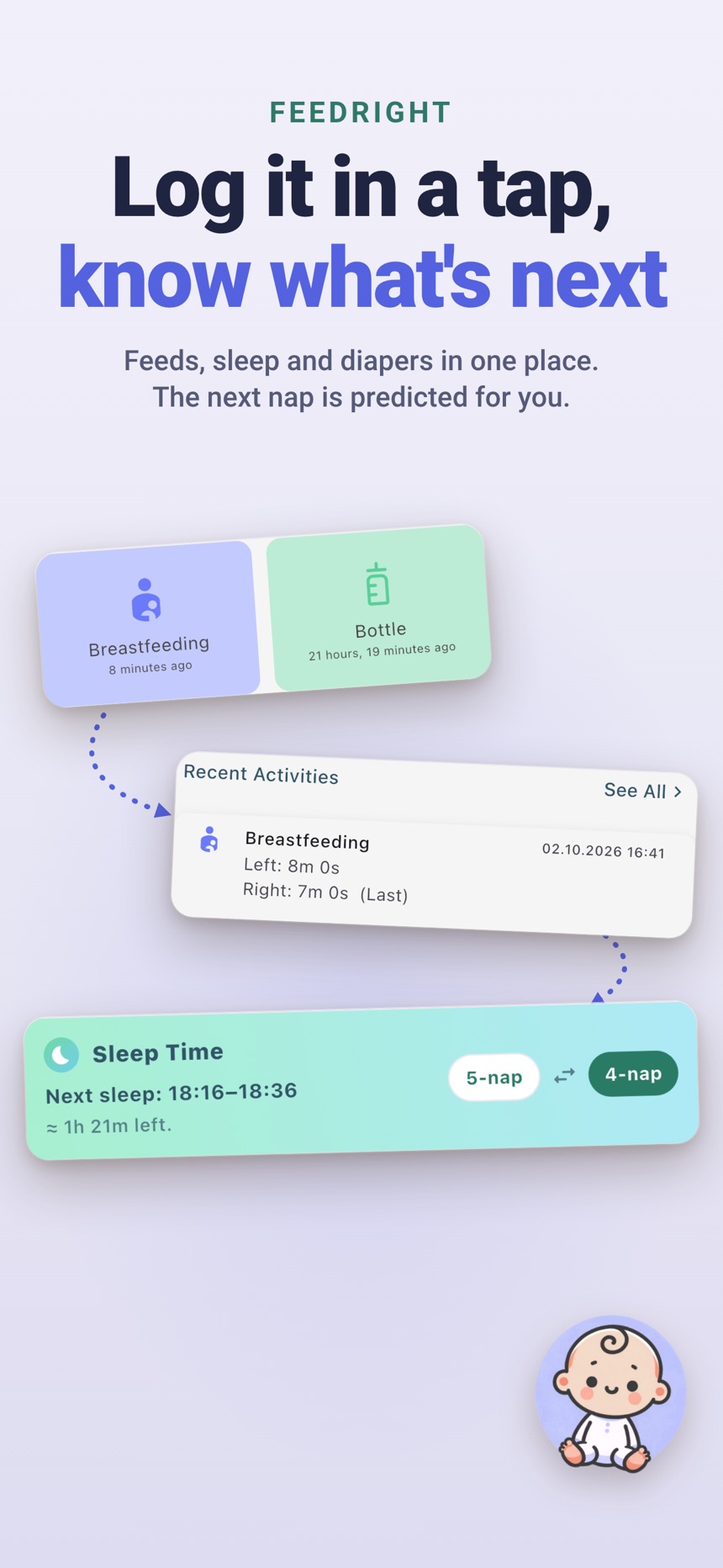
- Diaper logs for wet, dirty, or both, plus medicine, temperature, and growth.
- A daily summary and history for the quick look before a handoff.
- With FeedRight Premium, a partner, grandparent or nanny can join your family by invite code, and every phone stays in sync.
Frequently asked questions
Should I track every newborn activity?
No. Start with the routines that make your day easier to coordinate, usually feeds, diapers, sleep, and short notes. Add more only if the extra detail is useful and does not make logging feel like a burden.
Can a newborn care log replace advice from a pediatrician?
No. A log records observations and timing; it does not explain health concerns or tell you what care your baby needs. If you are concerned, contact your pediatrician and share the record as helpful context.
What if I forget to log part of the day?
Pick up with the next event you remember. An imperfect record can still make the next handoff easier, and trying to recreate every missing detail usually adds more stress than value.
How long should I keep a newborn care log?
Keep it for as long as it helps. Many parents log closely in the first weeks and simplify once routines feel more familiar, while others keep a light log for handoffs and appointments.
Who should write in the newborn care log?
Anyone who cares for the baby can add entries, and it works best when each person logs their own shift. Agree on simple labels so one parent does not become the household record keeper by default.
Is a paper newborn care log enough?
Yes, if it stays where care happens and everyone uses it. Paper is private and easy to leave by the couch, while a baby tracker app is easier to share and to scan for the latest entry.