

Night feeds don’t automatically signal a bad routine; they show what happened during a demanding stretch of the day. When you are awake at 2 a.m., it is easy to remember only the hardest wake-up and miss the bigger pattern. Looking at night feed results over several days can replace that foggy feeling with a calmer, more accurate picture.
Quick answer: Night feed results are most useful as a record of patterns, not a scorecard for how your baby or your family is doing. Review several nights together and look at timing, spacing, and changes in routine rather than one hard night. Leave medical questions and feeding concerns to your pediatrician, and bring the log along.
This guide is general information, not medical advice. Every baby is different, so ask your pediatrician or health visitor about your own baby.
What are night feed results?
Night feed results are the information you see after recording overnight feeds, such as when feeds happened and how they were spaced across several nights. The value is not in one isolated entry. It is in the trend that becomes visible when the same details are captured consistently.
A night can feel endless even when it included only a few brief interruptions. Another can feel manageable despite more wake-ups because the timing worked better for the household. Memory is shaped by exhaustion, which is why a written record can be kinder than trying to reconstruct the night the next morning.
Why does a pattern matter more than one night?
Parents often look for a single explanation after a rough evening: a new routine, a busy day, a missed nap, a change in the room, or simply bad luck. Sometimes there is a clear connection. Often there is not enough information to tell from one night alone.
A few nights of notes create context. You may see that feeds tend to cluster at a similar point in the night, that a stretch has gradually changed, or that there is no stable pattern at all. That last result is useful too. It can stop you from changing everything based on one difficult night.
The goal is not to turn parenting into a spreadsheet. It is to give tired adults a small amount of reliable information when their memory is understandably overloaded. A quick record also makes handoffs between caregivers easier, especially when each person remembers the night a little differently.
Unlike relying on morning memory alone, a consistent feeding log lets you spot routine changes without replaying the whole night in your head.
How do you read night feed results without overthinking them?
Start by looking at a week rather than hunting for meaning in yesterday’s entries. A longer view softens the impact of an unusually hard night and makes repeated timing easier to see. If you only logged a few nights, that is still a starting point, not a failed dataset.
Use a short set of questions for your weekly look:
- When did overnight feeding usually begin?
- Were there stretches that happened at roughly similar times?
- Did the pattern look different on nights when another caregiver handled part of the routine?
- Are there gaps in the log that might be missed entries rather than missed feeds?
- Is there anything you want to ask your pediatrician about?
These questions are practical because they describe what happened without assuming why it happened. Then consider what would actually help. If a certain part of the night is consistently busy, a caregiver might plan a smoother handoff or keep the basics within reach before bed. Our guide on how to manage night feeds without losing track has more ideas. If the results are scattered, the best response may be to keep observing. Not every pattern needs a fix.
Be careful with labels like “good” and “bad.” A log can describe frequency and timing, but it cannot capture every part of family life, your baby’s development, or how rested you feel. The same results may be manageable for one household and exhausting for another.
How small should a night feeding log be?
The most useful tracker is usually the one you can update with one tired hand. If logging asks for too many details, it may get skipped on the nights when you need it most. Start with the time of each feed and, if useful, a simple note for the feeding type.
You might add which caregiver handled the feed, particularly if you are coordinating nights. That clarifies the record without turning it into a performance report. The point is shared awareness, not measuring who did more.
Avoid building conclusions on missing data. A blank entry may mean no feed happened, but it can also mean someone was too tired to log it. Before deciding that a routine changed, check whether the record itself was consistent.
Keep nighttime notes separate from daytime reflection. At night, capture only what is easy. The next day, when everyone is more awake, take a minute to notice whether anything stands out. That small separation keeps the log from becoming another task at the hardest hour.
Keep the log to a few useful details.
| What to note | Why it helps |
|---|---|
| Time of each feed | Shows how feeds cluster and are spaced |
| Feeding type | A simple note, only if useful |
| Who handled the feed | Clarifies the record when you share nights |
| Gaps in the log | May be a missed entry, not a missed feed |
| Reflections | Save them for the next day, when you are rested |
When are night feed results worth bringing up?
Tracking can help you have a clearer conversation with your pediatrician or health visitor if you have questions about feeding or your baby’s well-being. A record gives you dates and timing rather than a vague “a lot lately.” It does not replace professional guidance, and it should not be used to make medical decisions on its own. For general background on what is typical, the AAP explains how often and how much babies usually eat.
Results also support communication at home. If one caregiver takes the early shift and another takes the later shift, a shared record reduces the need for a half-awake recap. It can make the invisible work of the night visible in a gentle, factual way.
There is a trade-off. Some families find tracking reassuring; others find it makes them watch every change too closely. If logging adds stress instead of clarity, simplify it, take a break, or keep only the details you use. A tool should lower the mental load, not add to it.
What does realistic progress look like at night?
Progress is rarely a straight line, especially at night. A calmer stretch can be followed by several unpredictable nights, and neither one is proof that you are doing something right or wrong. The useful question is not whether every night improved. It is whether the information helps your household feel more prepared.
That perspective changes how you use night feed results. Instead of asking a log to promise what will happen tomorrow, use it to understand what has been happening lately. If you are wondering when longer stretches tend to appear, see when babies sleep longer: a realistic timeline.
For many parents, that is enough. You do not need a perfect record, a complicated dashboard, or an explanation for every wake-up. You need a simple way to see the nights as they were, one nap time at a time.
How FeedRight helps
FeedRight Baby Tracker keeps night logging to one tap and shows how long ago the baby last ate and which side you finished on, which is often the first question at 3 a.m. Download it on the App Store or Google Play.
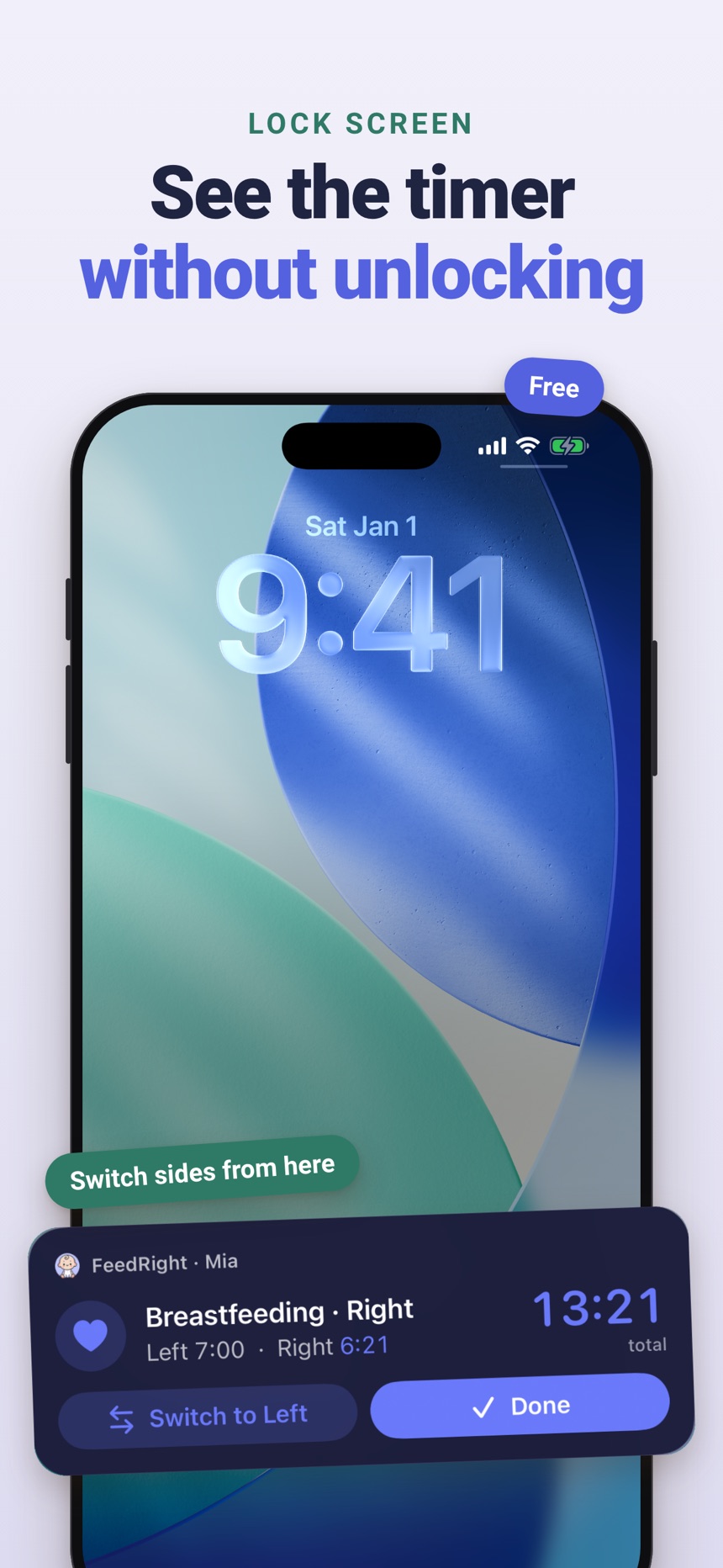
- Breastfeeding timer for left and right, with live timers on the iPhone Lock Screen and Dynamic Island.
- Daily summary, history, and statistics for the last 3 days for free.
- FeedRight Premium adds full 7 and 28 day statistics for a longer view.
Frequently asked questions
Should I judge night feed results after one difficult night?
No. One night is worth recording, but it rarely gives enough context for a meaningful conclusion. Review several nights when possible, and treat unusual nights as part of the picture rather than the whole story.
What details should I track overnight?
Start with feed times and keep the record brief. You can add feeding type or caregiver if those details help your family coordinate, but skip any field that makes consistent logging harder.
Can a feeding log replace asking a pediatrician?
No. A log can help you describe patterns clearly, but questions about feeding, health, or your baby’s well-being belong with your pediatrician or health visitor.
How many nights of feeding logs should I review?
About a week is a good window for spotting a rough pattern, though even a few nights can help. Compare nights side by side and check for missed entries before drawing conclusions.
How often do babies feed at night?
Many newborns feed every two to three hours around the clock, and longer night stretches usually appear gradually over the first months. Your pediatrician can tell you what is typical for your baby’s age and growth.
Why does my baby suddenly feed more at night?
Growth spurts, developmental changes, illness or a day with shorter feeds can all make nights busier for a while. Look at several nights of logs before drawing conclusions, and call your pediatrician if feeding seems difficult or wet diapers drop.