

Your baby is crying again and you are trying to remember: did you feed them an hour ago, or was it two? Your partner thinks it was around midnight. You think it was later. Neither of you is sure.
This is one of the most common frustrations new parents run into, and it happens every day. You are not forgetful. You are running a brain that was not designed for sleep deprivation, a crying baby and a mental checklist all at once.
Quick answer: If you forgot when your baby last fed, you are not alone, and the fix is not trying harder to remember. Log each feed the moment it starts, ideally with a one-tap timer, keep the log within reach wherever you feed, and have every caregiver use the same log. Then “when did the baby last eat?” takes a glance instead of a guess.
This guide is general information, not medical advice. Every baby is different, so ask your pediatrician or health visitor about your own baby.
The issue is not your memory. The issue is expecting memory to work under conditions where it was never going to.
Why is it so easy to forget when your baby last fed?
What does it mean to lose track of feeds?
Losing track of feeds means you can no longer say when the last feed started, how long it lasted, or in what order the night’s feeds happened. It usually happens because feeds are frequent, come at irregular hours, and fall in a state of exhaustion.
Newborns often feed 8 to 12 times in a 24-hour period, according to the American Academy of Pediatrics. That is roughly every two to three hours, around the clock, though every baby is different and your pediatrician can tell you what to expect for yours. When feeds are that frequent, they blur together. The 2 a.m. feed looks exactly like the 4 a.m. feed, which looks exactly like the 6 a.m. feed.
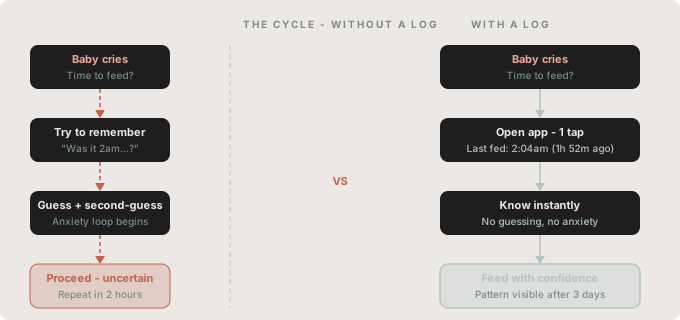
Most parents try to keep a mental note: “Last feed was around two.” But by the next feed, they cannot remember if that was an hour ago or two. And if they lost track the night before, there is no record to look back at.
Why does sleep deprivation make recall unreliable?
This is not a parenting failure. Broken sleep makes it harder for anyone to hold on to details and judge how much time has passed. You may feel present and functioning, but asking yourself “when did I last feed the baby?” after four hours of broken sleep is asking a tired brain to do precise recall. It will fail regularly, and that is not your fault.
Why is the guessing loop so exhausting?
When you cannot remember, you guess. Then you question the guess. Then you ask your partner, who also guesses. You land on an approximate time and carry on, but now there is low-level anxiety running in the background. Did you wait too long? Should you feed again now just to be safe?
This loop of guess, second-guess and proceed with uncertainty can happen several times a day in the newborn phase. It is not the single moment that is hard. It is the fact that it never stops.
What is the simple fix when you forget when baby last fed?
The fix has three parts, and none of them requires willpower:
- Log the feed the moment it starts, not after.
- Keep the log where you feed.
- Share one log with every caregiver.
In short, here is why each habit works.
| Habit | Why it works |
|---|---|
| Log the feed the moment it starts | Logging later relies on recall, and the start time blurs |
| Use a one-tap timer | The time and duration are recorded for you |
| Keep the log where you feed | If the phone or notebook is in another room, the feed goes unlogged |
| Share one log with every caregiver | A partner’s 3 a.m. feed is there when you wake up |
Log the moment it starts, not after
Start the log when the feed begins, not when it ends, and never from memory later. If you wait until after the feed, you are already relying on recall. By the time the baby is burped, changed and back down, the exact start time has blurred.
A one-tap feeding timer for newborns makes this work in practice. Tap when the feed starts, tap when it ends, and the time and duration are recorded. The next time someone asks when the baby last fed, you open the log and there it is.
Keep the phone where you feed
Friction is the enemy of any new habit. If the phone is in another room, you will not log the feed. If the app takes ten seconds to open and navigate, you will not log the feed.
Put your phone, with the tracker ready, wherever you feed most often: nursing chair, bedside, couch. When the feed starts, tap. Our guide on how to manage night feeds has more ideas for setting up the overnight shift.
Share one log with your co-caregiver
If two people are doing night feeds, one log only works if both people use it. With a shared tracker, your partner’s 3 a.m. feed is in the log when you wake up. No “did you log that?” conversation, no reconstructing the night in the morning.
This matters most in the first weeks, when shifts blur and handoffs are frequent. See whether parents can share feeding logs between caregivers for setups that work.
What does a consistent feeding log tell you?
Once you stop guessing and start logging, patterns emerge. Many newborns develop loose feeding rhythms within the first few weeks: cluster feeding in the evenings, a longer stretch overnight, shorter gaps during the day.
None of that is visible when you are guessing from memory. A week of logged feeds makes it clear. You start to anticipate the next feed instead of reacting to it, and that rough predictability makes the newborn phase more manageable. If you notice a sudden change, such as much shorter feeds or fewer wet diapers, mention it to your pediatrician.
For a full system that covers feeding, sleep and diapers together, see our guide on how to track newborn feeding, sleep and diapers.
Why stop relying on memory for feeding times?
Memory is not a reliable system for newborn feeding times, and it is not supposed to be. Expecting it to timestamp events precisely under heavy sleep deprivation creates unnecessary stress.
The solution is removing the reliance on memory entirely. A log that runs in real time means you never have to reconstruct the night or guess at intervals, because the record exists and it is accurate. A newborn routine app is one way to do it; a notebook by the chair is another, as long as it is always there.
How FeedRight helps

FeedRight Baby Tracker was built for exactly this situation. It shows how long ago your baby last ate and which side you finished on, the moment you open the app, on iPhone, Apple Watch and Android.
- One tap starts a breastfeeding or bottle timer; every feed is timestamped. Free, no account needed.
- Live feed timers on the iPhone Lock Screen and Dynamic Island, and an optional reminder a few hours after the last feed.
- Optional FeedRight Premium adds family sync, so both phones show the same log.
Treat it as a backup for your memory, not as medical advice. You can install it from the App Store or Google Play.
Frequently asked questions
What should I do if I forgot when my baby last fed?
Watch your baby’s hunger cues, such as rooting, sucking on hands or stirring, and offer a feed if they seem hungry. Then start logging each feed from now on so you do not have to guess next time.
How often do newborns need to eat?
Many newborns feed about 8 to 12 times in 24 hours, roughly every two to three hours. Your pediatrician can tell you what is right for your baby, especially in the first weeks.
What is the easiest way to remember feeding times?
Log the feed the moment it starts with a one-tap timer or a notebook kept where you feed. Logging later from memory is where most mistakes happen.
Can both parents see the same feeding log?
Yes, if you use one shared log. A single notebook works if it stays in one place, and apps such as FeedRight can sync both phones with an optional Premium plan.
What are early hunger cues in a newborn?
Early hunger cues in a newborn include rooting, sucking on hands, lip smacking and stirring from sleep. Crying is usually a late cue, so offering a feed at the early signs tends to be calmer for both of you.
How do I know if my newborn is getting enough milk?
Steady weight gain, regular wet and dirty diapers, and a baby who seems content after most feeds are the usual signs that a newborn is getting enough milk. Your pediatrician checks weight at early visits and can tell you what to expect for your baby.