
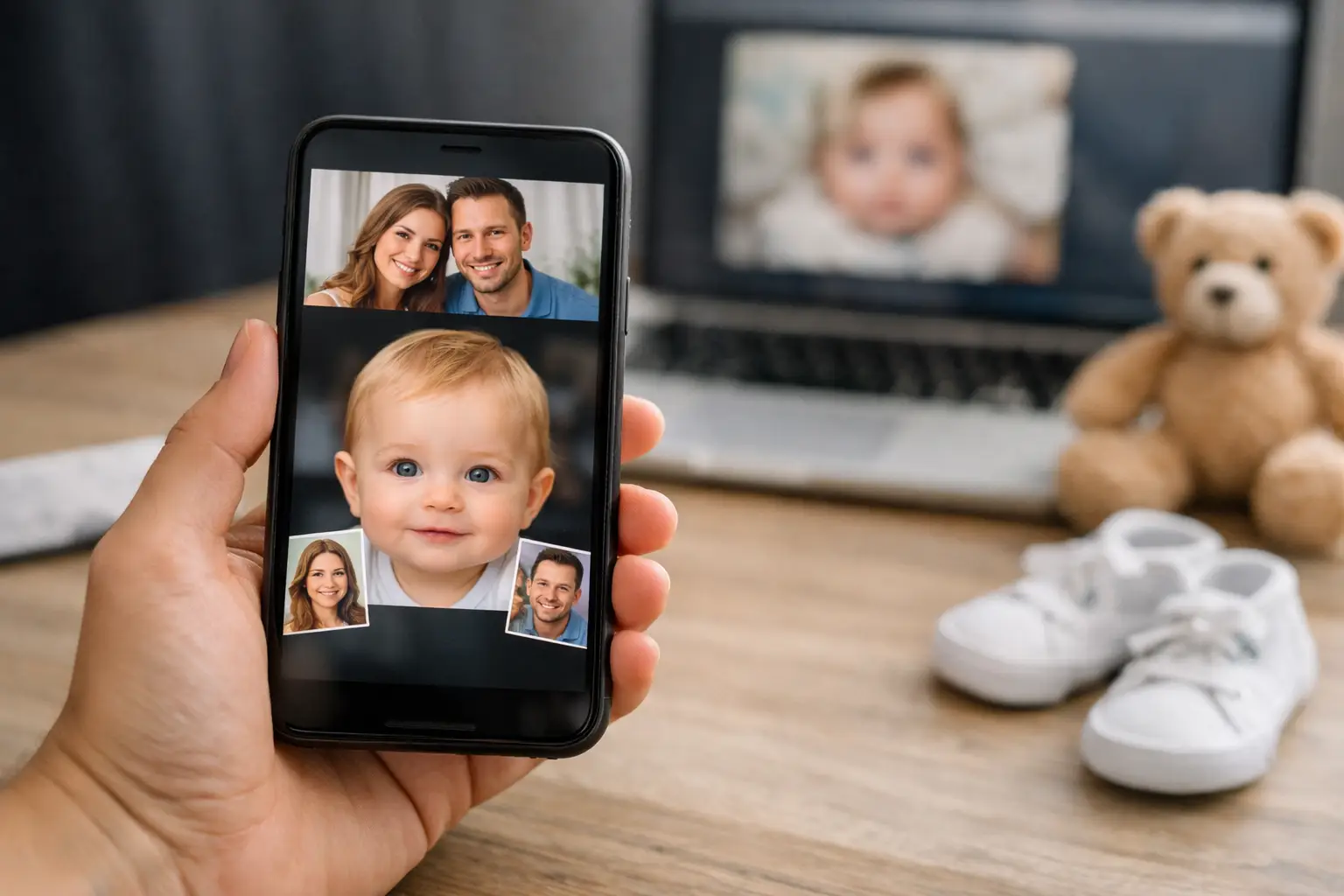
A “what will my future baby look like” app is one of those small, delightful ways technology can turn a passing thought into something you can share. You add a photo of each parent, wait a moment, and get an AI-generated baby portrait. It can be funny, sweet, surprising, and a little surreal, especially when the result looks uncannily like a childhood photo from either side of the family.
Quick answer: A “what will my future baby look like” app takes one photo of each parent and creates an AI-generated portrait of an imaginary child. It works from visible patterns in the photos, not from genes, so it cannot show how a real baby will look. Use it as a fun conversation starter, and check how the app handles your photos first.
Used with that expectation, it can make a date night, baby shower, family group chat, or quiet curious moment more memorable.
What does a future baby look like app actually do?
These apps use artificial intelligence to pick up visible features in two photos, then create a new baby-style image that blends them. That may include face shape, eye area, hair color, skin tone, and smile. The app is not reading genetics, studying family medical history, or calculating inherited traits the way a genetic test would.
Instead, it creates a believable image based on visual patterns learned from many examples. Think of it as a creative photo generator, not a crystal ball. It makes an informed-looking guess about what a child might look like, but it cannot know which features a real baby would inherit.
That matters because genetics are wonderfully complicated. Most visible traits involve several genes plus chance, as MedlinePlus Genetics explains in its guide to inherited traits. A child can resemble one parent strongly, look like a grandparent, or have a combination nobody expected. Hair and eye color can also change in the first few years of life. No app can settle those questions ahead of time.
Why do people enjoy these apps anyway?
Not every app needs to solve a serious problem. Sometimes a simple, focused tool gives people a moment of connection. A future baby generator gives couples a lighthearted thing to talk about beyond the usual plans, calendars, and practical decisions. It belongs to a wider group of AI curiosity apps built for one quick, fun question.
For expecting parents, it can be a fun way to imagine the family they are growing. For couples who are not ready for kids, it is a low-pressure curiosity. Friends may use it for silly comparisons, while grandparents may happily point out that the generated baby has “definitely got our eyes.”
The best experiences come from keeping the stakes low. The image is a conversation starter, not a promise. If you approach it with curiosity rather than certainty, the surprise is part of the fun.
How do you get a better result from a future baby app?
The quality of the photos makes a real difference. AI works best when it can clearly see each face without guessing around shadows, filters, or busy backgrounds.
Choose a recent, front-facing photo where each person looks toward the camera. Natural light usually helps more than a dark room or intense sunlight. Use a relaxed expression and avoid sunglasses, hats, face masks, or hair covering much of the face. A clear solo photo is better than cropping one person from a group shot, and heavy beauty filters change the very details the generator uses.
If the first image feels odd, do not read too much into it. Try another pair of photos with different lighting or expressions. AI image tools can produce different results from the same people because each output is a new interpretation, not a fixed calculation.
A quick photo checklist
Before uploading, check for four simple things:
- Both faces are clear, centered, and well lit.
- Each photo shows only one person.
- There are no strong filters, sunglasses, or face-covering accessories.
- The photo is recent and looks like the person in everyday life.
These choices will not make the result genetically accurate, but they make it more recognizable and more fun to share.
What can the results tell you, and what can they not?
A generated baby portrait may combine familiar details in a convincing way. You may see one parent’s smile, the other parent’s hair, or a face that somehow reminds everyone of an aunt. That is exactly why these apps are entertaining. Our deeper look at whether AI can predict baby appearance explains why that resemblance is a visual effect, not a forecast.
A result cannot tell you whether a future child will have a certain eye color, hair texture, height, personality, health trait, or resemblance at a particular age. It also cannot account for features that are not visible in the uploaded photos. Family traits can skip generations, develop over time, or show up in ways no image generator could anticipate. The same is true of any AI baby face generator.
Be thoughtful when sharing results. A playful image may feel personal to someone dealing with infertility, pregnancy loss, or a complicated path to parenthood. Share with the people who will find the moment joyful, and keep the tone gentle.
| A result can show | A result cannot tell you |
|---|---|
| A blend of visible details, like one parent’s smile | Eye color, hair texture or height |
| A face that reminds people of a relative | Personality or health traits |
| One new interpretation on each try | Resemblance at a particular age |
| A fun image to share | Features not visible in the uploaded photos |
Why is privacy part of the choice?
Photos of faces are personal. Before using any AI image app, take a minute to understand what happens after you upload. Look for plain language about photo storage, deletion, and whether images are used to improve the service. If you are deciding between tools, our guide to AI baby visualizers compared lists what to look for.
A good future baby generator should also be upfront about its purpose. It should not imply that it provides medical, genetic, or scientific answers. The output is an AI-created image for entertainment and curiosity.
Ask first before using a partner’s image, and avoid uploading photos of children unless you are comfortable with the app’s privacy practices. A few seconds of care keeps a fun experiment from becoming an awkward conversation.
Why is a fun prompt better than a forecast?
A future baby app works best when it gives you a little room to imagine. Maybe it sparks a warm conversation about childhood photos. Maybe it becomes a cute addition to a baby shower game. Maybe it is five minutes of curiosity on the couch together. If you are using it with a partner, try guessing which features you will each notice first before you look.
Let the image be a playful possibility, then put the phone down and enjoy the real people in front of you. The future has a way of making its own face.
How Future Baby AI Generator keeps it simple
The most enjoyable apps do not make you fight through a long setup. For this idea, the experience should be straightforward: choose two clear photos, create an image, smile at the result, and decide whether it is worth saving or sharing. That is the thinking behind Future Baby AI Generator from Digital Traffic Labs. It is built for the curious, playful moment, not for making claims about genetics.
- Add Parent 1 and Parent 2 from your photo library, then choose boy or girl and an age range from baby to teenager.
- The image is ready in seconds and labeled as AI-generated. Save it to Photos or share it.
- No sign-up is needed. Photos are used only to create the image and are not stored by the app.
Learn more on the Future Baby AI Generator page or download it from the App Store.
Frequently asked questions
Can an app show what my baby will look like?
No. An app can create an imagined, AI-generated portrait from two photos, but it cannot show how a real child will look. A child’s appearance depends on many genes and on chance.
Do future baby apps use DNA or genetics?
No. They work only from what is visible in the photos you upload, such as face shape and hair color. They do not read genes or family history.
Which photos work best in a future baby app?
Recent, front-facing solo photos with even lighting and no sunglasses, hats, or heavy filters. Clear photos make the result more recognizable, but not more accurate.
Is Future Baby AI Generator free?
It is free to download, but creating images requires a subscription with credits, and there are no free generations. One image uses one credit, and a failed image does not use a credit.
Is there a way to know what my baby will look like?
No. There is no reliable way to know what a baby will look like before birth, because appearance depends on many genes and on chance. A future baby app can only create an imagined portrait for fun, and a child’s features, hair and eye color keep changing in the first years.
Is it safe to upload photos to a future baby app?
Check the app’s privacy information first, and look for plain language about whether photos are stored, how they are deleted and whether they are used to improve the service. Ask before using a partner’s photo, and be careful with photos of children.