
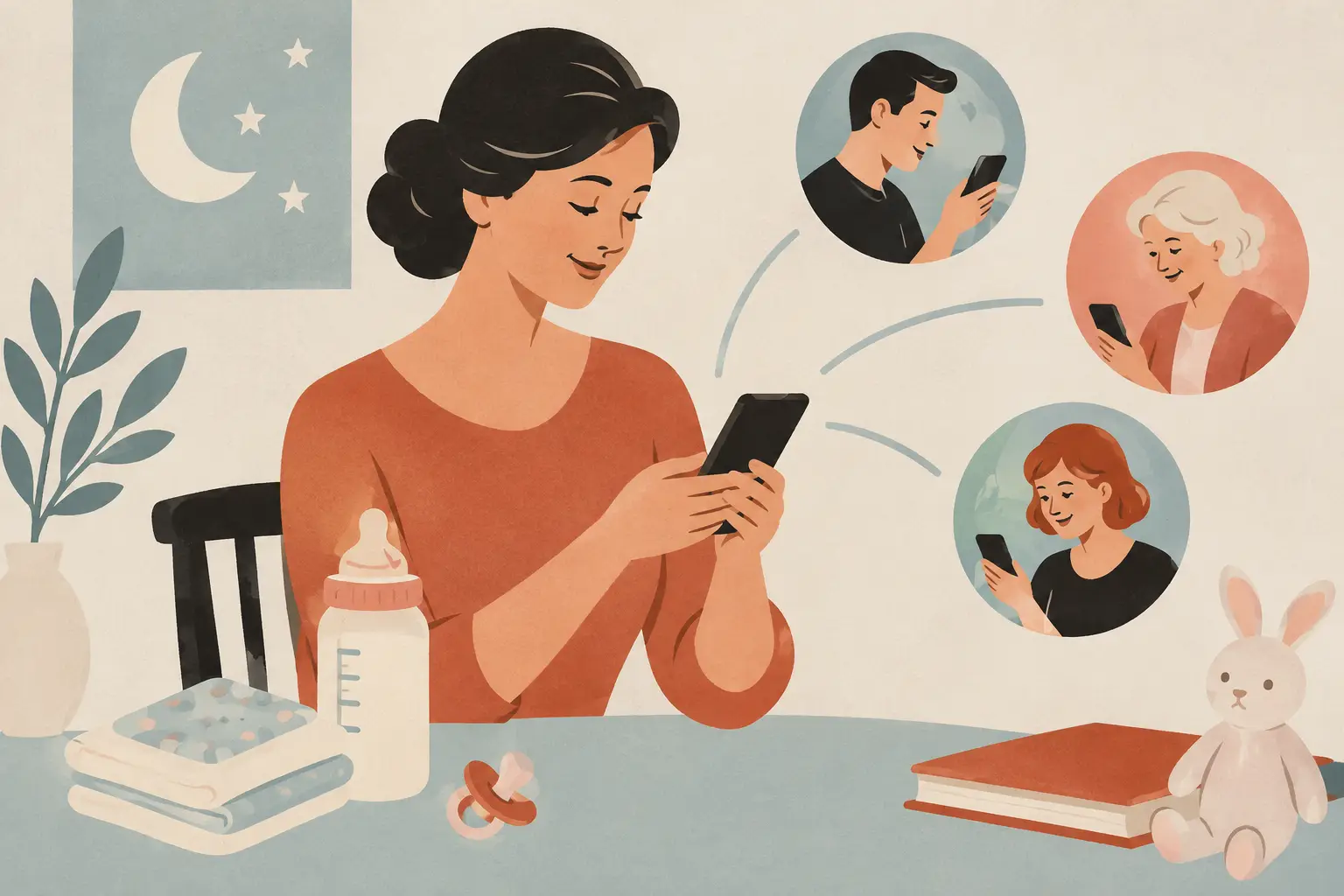
A baby log doesn’t help when it stays on one parent’s phone; it helps when the next caregiver can see it. The real challenge in learning how to share baby logs is not collecting more details. It is making the right details easy to find when someone is holding a fussy baby, walking into a handoff, or trying to remember what happened before the last nap.
Quick answer: To share baby logs, keep one shared record that every trusted caregiver can see, agree on a small set of entries (last feed, sleep, diaper, and a short note), and let whoever does the care log it right away. Use the group chat for quick questions, not as the official record, and check the log together at each handoff.
This guide is general information, not medical advice. Every baby is different, so ask your pediatrician or health visitor about your own baby.
What is a shared baby log?
A shared baby log is a single, current record of everyday care such as feeds, sleep, diaper changes, and notes that more than one trusted caregiver can check and update. It gives everyone the same starting point, whether they are together or taking turns.
Unlike separate notes, texts, and memory, a shared baby log lets you see the latest care information without asking someone to reconstruct the day.
How do you share baby logs without adding work?
Start by choosing the people who truly need access. For many families, that means two parents or partners. It may also include a grandparent, nanny, daycare provider, or another caregiver who regularly covers a block of time.
More access is not always more useful. A wide group can create duplicate entries, questions in several places, or the uncomfortable feeling that every routine is being watched. Keep the sharing circle practical, and revisit it when care arrangements change.
Then agree on the smallest useful set of entries. Most families need a quick view of the last feed, sleep, and diaper change, plus a place for a short note when something affects the handoff. If a detail never helps the next caregiver make sense of the day, it may not need logging.
Simple beats comprehensive. A system that takes a few seconds and gets used is more valuable than a detailed spreadsheet that one person maintains for three days.
Give each entry a clear owner
When two people are home, it is easy to assume the other person recorded something. Decide on one default: the person who does the care logs it, ideally right after it happens. That one small expectation prevents most gaps.
There will be exceptions. One person may be driving, carrying groceries, or calming the baby while the other enters the note. That is fine, as long as the handoff is explicit: “Can you add the last bottle?” is much clearer than “Did you get that?”
For a caregiver who only helps occasionally, ask them to record the basics during their shift and leave a brief handoff note before they go. The goal is not surveillance. It is making the next hour easier for the person taking over.
Keep notes short and useful
A baby log is not a diary. Notes work best when they answer a question the next caregiver is likely to have, such as whether the baby fell asleep in the car, seemed unusually upset during a routine, or has a schedule change to account for.
Use plain language your household understands. “Asleep in stroller at 10:40” is more useful than a long play-by-play. If you need to discuss a concern about feeding, sleep, development, or health, the log can help you remember what happened, but your pediatrician is the right person for medical guidance.
Avoid vague labels that mean different things to different people. “Good nap” may feel clear in the moment, but a time and a short context note are easier to interpret later.
Which sharing method fits your routine?
There is no one correct tool for every household. Pick the option that matches where care happens, rather than the one with the most settings.
| Method | Works well when | Weak spot |
|---|---|---|
| Paper sheet on the counter | Caregivers share the same home | Cannot be checked from work or daycare |
| Shared note or spreadsheet | A short-term arrangement | Layout drifts, timestamps get unclear |
| Group chat | Quick questions, photos, “running late” | Messages pile up; hard to find the last sleep |
| Baby tracker app | Parents are apart or several caregivers need the current record | Everyone needs the app and agreed access |
If you use a shared note or spreadsheet, keep its layout obvious. Put the newest entry where people expect to see it, use consistent labels for the same events, and do not turn it into a running chat.
A messaging thread is helpful for immediate questions, photos, or a quick “we are running late.” It is less helpful as the official record. Messages arrive out of order, get missed during busy moments, and are hard to scan when someone only needs the last logged sleep.
Make handoffs a tiny ritual
The best time to catch missing information is at the handoff, not hours later. Before one caregiver leaves or another takes over, look at the current log together. Confirm what happened most recently and mention anything that does not fit neatly in an entry.
Keep this brief. A useful handoff might be: “Last feed is logged, diaper was just changed, and the baby fell asleep a few minutes ago.” That gives the incoming caregiver context without a meeting every time someone walks through the door. If several people rotate through the week, pair the log with simple caregiver schedule templates.
For daycare or a sitter, decide in advance when updates are expected. Some families prefer one summary at pickup. Others need updates during the day because of work schedules or shared responsibilities. The right rhythm depends on your situation and the caregiver’s usual process.
How do you protect privacy without making sharing hard?
Baby logs can contain private family information, so treat access thoughtfully. Share only with people who provide care, use an account or device you trust, and remove access when an arrangement ends. This matters even when the caregiver is a close relative.
Separate useful care notes from information that does not need to be widely visible. A log should make routines clearer, not become a storage place for every family conversation. When a note feels sensitive or needs a longer discussion, have that conversation directly.
If more than one device is involved, make sure everyone knows which record is the current one. Duplicate systems create the same confusion as no system at all. One source of truth is the real benefit of sharing.
What if a shared log starts feeling like too much?
Some parents stop logging because the system starts to feel like homework. That is a good signal to simplify, not to push harder. Remove fields nobody uses, shorten notes, or log only the events that make transitions between caregivers easier. Our piece on whether parents need routine logs at all can help you decide how much is enough.
Your needs will change too. The first weeks at home can involve frequent handoffs and lots of uncertainty. Later, a short routine summary may be enough. A shared log should adapt to the family, one nap time at a time.
It is also okay for two caregivers to care about different details. One person may want timestamps; another may mostly need confirmation that a task happened. Agree on the essentials, then leave room for personal preferences. Couples can find more ideas in a shared baby tracker for couples that works.
How FeedRight helps
FeedRight Baby Tracker is built for this kind of shared record. It logs feeds, sleep, and diapers in one tap and shows how long ago the baby last ate, so the next caregiver has the answer before asking. Every caregiver can install it from the App Store or Google Play.
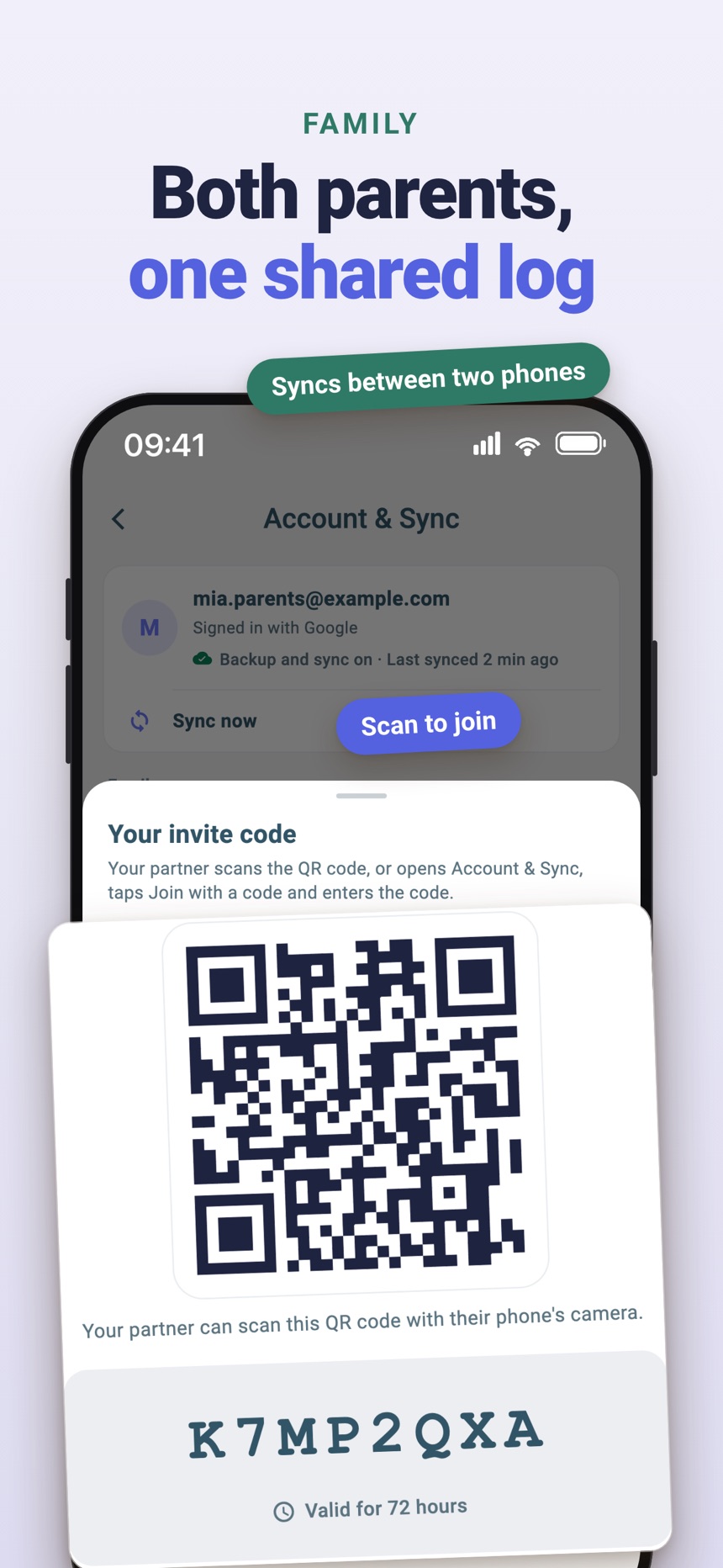
- A partner or another caregiver, like a grandparent or a nanny, joins your family with an invite code or QR code.
- With FeedRight Premium, one plan covers the family, your partner and other caregivers join free with every Premium feature, and phones stay in sync across iPhone and Android.
- No account is needed to start; sign-in with Apple or Google is optional.
Frequently asked questions
Should both parents update the baby log?
Usually, yes. The simplest rule is that the person providing care logs it, unless they clearly ask the other person to do it. That keeps the record current without making one parent the default administrator.
Can I share baby logs with a nanny or grandparent?
Yes, if they regularly care for your baby and understand what to record. Keep access limited to trusted caregivers, agree on the basic entries, and remove access if the care arrangement ends.
Is a group chat enough for sharing baby updates?
A group chat is useful for quick questions and photos, but it is not ideal as the main log. A single record makes it much easier to find the latest feed, sleep, diaper, or handoff note without scrolling.
Can parents with an iPhone and an Android phone share one baby log?
Yes, if the tool works on both platforms. A paper sheet always works; among apps, FeedRight Premium keeps a family’s phones in sync across iPhone and Android.
What should a shared baby log include?
A shared baby log should show the last feed, sleep and diaper change, plus a short note when something affects the next handoff. Leave out details that never help the next caregiver.
How do I keep a shared baby log private?
Share access only with people who provide care, use an account or device you trust, and remove access when a care arrangement ends. Keep sensitive family conversations out of the log and have them directly.