

That tiny newborn may not look ready for much beyond feeding, sleeping, and being held. But when to start tummy time is usually sooner than many new parents expect: you can begin as early as your baby’s first days home, as long as they are awake, supervised, and placed on a firm, flat surface.
The early sessions do not need to look impressive. A minute on your chest, a few tries on a play mat, or a calm moment after a diaper change all count. The goal is not to make your baby work hard. It is to build a gentle, repeatable habit that helps them get comfortable being on their belly.
Quick answer: Most healthy, full-term babies can start tummy time in the first days home, as long as they are awake and an adult is watching. Begin with a few short sessions a day and build gradually toward about an hour in total by around 3 to 4 months. Ask your pediatrician if your baby was born early or has a medical condition.
This guide is general information, not medical advice. Every baby is different, so ask your pediatrician or health visitor about your own baby.
When should you start tummy time?
Most healthy, full-term babies can start tummy time right away. The American Academy of Pediatrics recommends supervised tummy time from the newborn period, beginning with short sessions two to three times a day and gradually increasing from there.
For many families, chest-to-chest tummy time is the easiest first step. Recline slightly, place your awake baby on your chest, and talk or sing to them. They can see your face, hear your voice, and practice lifting or turning their head without the unfamiliar feeling of being alone on the floor.
Once that feels comfortable, try the floor. Lay a clean blanket or play mat on a firm surface and place your baby on their tummy for a short, closely watched session. Start with whatever your baby can manage, even if that is only 30 seconds. Several tiny sessions throughout the day add up quickly.
If your baby was born early or has a medical condition, ask their pediatrician for guidance tailored to their needs. Preterm babies may follow their adjusted age for some developmental expectations. The right plan can also vary for babies with reflux, breathing concerns, low muscle tone, hip issues, or a recent medical procedure.
Why does tummy time matter?
Tummy time gives babies a chance to practice the movements that later support rolling, sitting, crawling, and reaching. While they are awake on their belly, they strengthen muscles in the neck, shoulders, arms, back, and core.
It also reduces the amount of time spent with pressure on the back of the head. Babies should always sleep on their backs, which is the safest sleep position, as the AAP’s parent’s guide to safe sleep explains. Tummy time is the awake, supervised counterbalance that gives them a different position during the day.
There is another benefit that is easy to miss in the early weeks: confidence. At first, your baby may briefly lift their head, turn it to one side, or simply rest their cheek on the mat. These small efforts are real practice. With time, they learn that they can move, look around, and push up a little more.
Try not to treat tummy time like a milestone test. Babies build skills at different speeds, and a fussy day does not mean you are behind. Consistency matters much more than a perfect session.
How much tummy time does a baby need?
In the newborn stage, think in minutes rather than long workouts. The ranges below are general targets; your pediatrician can tell you what fits your baby.
| Age (approx.) | Tummy time per day | Session length |
|---|---|---|
| Newborn | A few short sessions | 1 to 3 minutes, or less |
| Around 2 months | 15 to 30 minutes in total | A few minutes at a time |
| 3 to 4 months | Building toward about 60 minutes in total | 5 to 10 minutes at a time |
That does not mean one continuous hour. A handful of five- or 10-minute sessions is much more realistic, especially fitted around naps, feeds, and errands. If your baby protests immediately, scale it back and try again later.
Some babies are happy on the floor in the morning but frustrated by late afternoon. Others do best after a diaper change or a short pause following a feed. Use the times that work instead of forcing a routine that creates stress for both of you. This real baby routine example shows how short activities can fit a flexible day.
If you like to see the small sessions add up, a quick note in a newborn care log or on paper is enough. It does not need to become another parenting task.
How can you make tummy time easier from the start?
The floor is great, but it is not the only option. If your baby dislikes being flat on their tummy, begin with a slight incline on your chest or across your lap. You can also roll up a small towel and place it under their upper chest, with their arms forward, while staying right beside them.
Get down at your baby’s eye level. Your face is usually more interesting than any toy. Smile, make simple sounds, or slowly move a high-contrast card or soft toy from side to side. A mirror designed for floor play can hold their attention once they begin noticing faces.
Timing helps. Avoid placing your baby on their tummy right after a full feeding, especially if they spit up often. Waiting 20 to 30 minutes may make the experience more comfortable. If that is not practical, a brief chest-to-chest session is a gentler alternative.
A little fussing is normal, particularly at first. Crying that escalates is a good reason to stop, comfort your baby, and try again later. You are teaching them that this position is safe and manageable, not trying to push through a hard moment.
What are the tummy time safety basics?
Tummy time is only for babies who are awake and actively supervised. Stay close enough to watch their face and breathing the entire time. If your baby falls asleep during tummy time, move them to a crib or bassinet and place them on their back for sleep.
Use a firm, flat surface such as a play mat on the floor. Avoid couches, adult beds, padded loungers, pillows, and other elevated or soft surfaces. These may seem cozy, but they increase the risk of a baby slipping into an unsafe position. You do not need positioning gadgets, heavy blankets, or lots of toys. A clear floor, a clean mat, and your attention are enough.
When should you check in with your pediatrician?
Every baby has off days, and some take longer to enjoy tummy time. Still, mention it at a checkup if your baby consistently cannot turn their head to both sides, always strongly favors one side, seems unusually floppy or stiff, or becomes very distressed during every attempt.
Call sooner if you notice breathing trouble, a blue or gray color around the lips, repeated choking, or a sudden change in how your baby moves. Those are not tummy-time issues to solve at home.
You can also ask for help if your baby has a flat area on their head or seems to resist looking in one direction. Your pediatrician may suggest simple repositioning strategies or refer you to a pediatric physical therapist. For the bigger picture of the early weeks, see our guide to tracking newborn feeding, sleep, and diapers.
How FeedRight helps
FeedRight Baby Tracker, our app for iPhone, Apple Watch and Android, focuses on feeds, sleep and diapers. Seeing how long ago the baby last ate makes it easier to pick a calm, awake moment for tummy time that is not right after a full feed. Logging is free, with no account to create. FeedRight is not a medical device. Get the app from the App Store or Google Play.
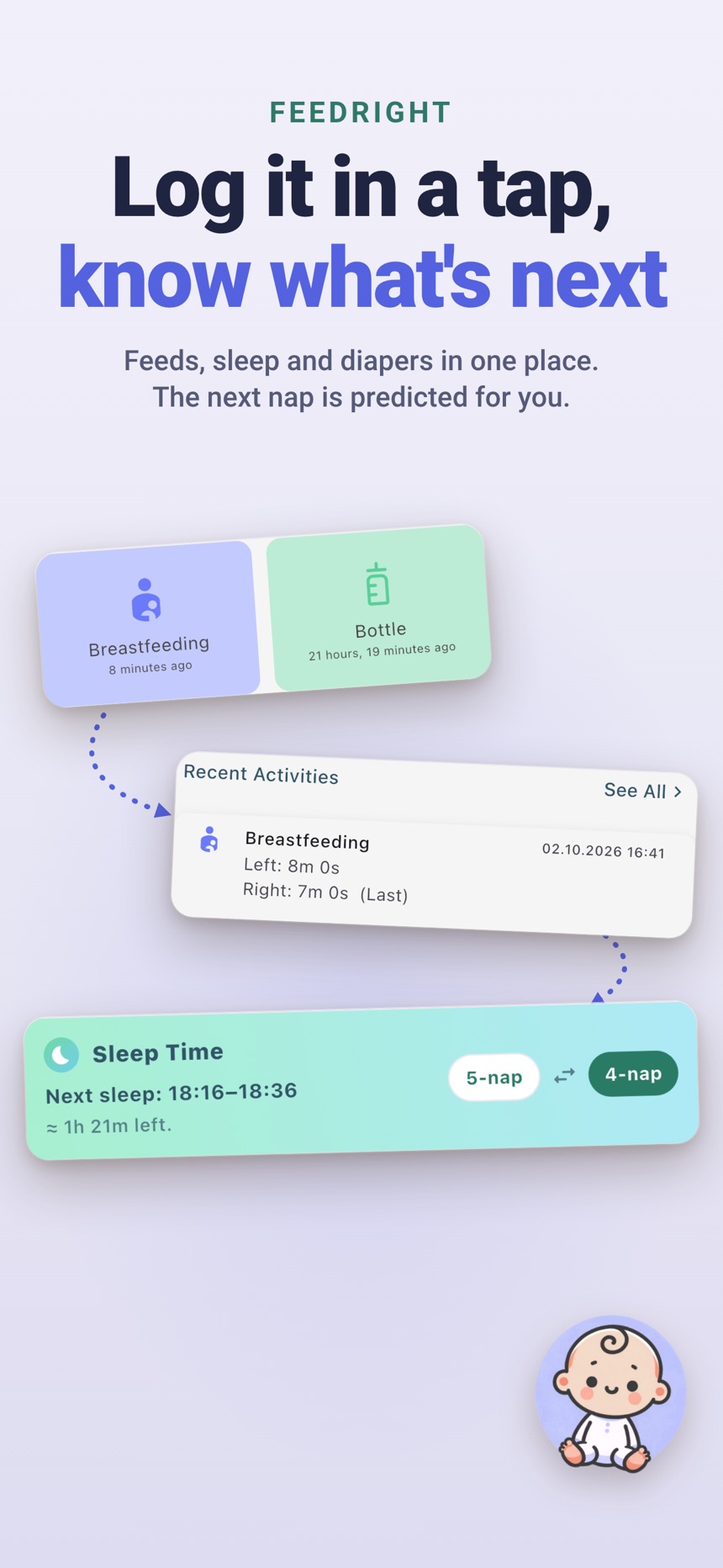
- Feeds, sleep and diapers sit together in the daily summary.
- From 3 months, a Sleep Time card estimates when the next nap is due.
- Growth entries show WHO percentiles as you enter them, to discuss at checkups.
The first tummy-time sessions may last less than a song. That is okay. Put your baby down for a minute, stay close, offer a familiar voice, and try again tomorrow. Like so much of early parenting, progress happens one small routine at a time.
Frequently asked questions
Can I do tummy time with a newborn?
Yes. Most healthy, full-term babies can start in the first days home with short, supervised sessions, often on a parent’s chest. Ask your pediatrician first if your baby was born early or has a medical condition.
How long should tummy time be for a 2-month-old?
A common goal is about 15 to 30 minutes in total across the day, in short sessions. Follow your baby’s cues and stop when they get upset.
What if my baby hates tummy time?
Start on your chest or across your lap, keep sessions very short, get down to eye level, and try at a time when your baby is rested and not right after a full feed.
Should you do tummy time before or after feeding?
Avoid tummy time right after a full feed, especially if your baby spits up often; waiting about 20 to 30 minutes may be more comfortable. Many babies do well after a diaper change or a nap, when they are awake and calm.
How much tummy time does a 3 month old need?
By around 3 to 4 months, many babies build toward about an hour of tummy time in total across the day, usually in sessions of 5 to 10 minutes. It does not need to be one continuous stretch, so follow your baby’s cues and ask your pediatrician what fits your baby.
What should I do if my baby falls asleep during tummy time?
Move your baby to their crib or bassinet and place them on their back to sleep. Tummy time is only for when your baby is awake and an adult is watching, on a firm, flat surface such as a play mat on the floor.