

A nap that lasted 22 minutes can feel like a personal insult when you were counting on an hour to answer emails, eat lunch, or simply sit down. The good news is that short, shifting, and occasionally chaotic sleep is a normal part of infancy. This baby nap patterns guide helps you spot what is typical, respond to your baby’s cues, and make small adjustments without forcing a perfect schedule.
Quick answer: Baby nap patterns change a lot in the first year. Newborns sleep in short, scattered pieces; many babies settle into three or four naps around 3 to 6 months, two or three naps around 6 to 9 months, and usually two naps by 9 to 12 months. Follow tired cues first, use the clock as a guide, and ask your pediatrician about your own baby.
This guide is general information, not medical advice. Every baby is different, so ask your pediatrician or health visitor about your own baby.
Why do baby nap patterns change so often?
Newborn sleep is scattered because newborns are still developing their internal day-and-night rhythm. They wake to feed often, sleep in short stretches, and may do their longest sleep at an inconvenient hour. During these early weeks, the goal is not a polished nap routine. It is feeding, comfort, safe sleep, and getting enough rest wherever you can.
As babies grow, their awake time usually stretches. Naps become easier to predict, then change again around developmental milestones, growth spurts, illness, travel, teething discomfort, or a new childcare routine. A baby who took four naps last week may resist the last one this week. That does not mean you broke the schedule. Their sleep needs may simply be moving.
It also helps to separate a pattern from a rule. A pattern is what your baby tends to do over several days. A rule is an expectation that every nap must happen at a certain time and last a certain length. Patterns are useful. Rules can make a hard afternoon feel harder.
What are typical baby nap patterns by age?
Age ranges are broad on purpose. Two healthy babies of the same age can have noticeably different nap needs. Use these as a starting point, then let your baby’s mood, sleep quality, and nighttime sleep fill in the rest. For a full-day view, see our baby sleep schedule guide for the first year.
| Age (approx.) | Typical naps | What to expect |
|---|---|---|
| Newborn to 3 months | Many, irregular | Short awake periods; sleep comes in pieces |
| 3 to 6 months | 3 to 4 | A rhythm starts to show; short naps are common |
| 6 to 9 months | 2 to 3 | The late catnap starts to fade |
| 9 to 12 months | Usually 2 | Morning and after-lunch naps |
Newborn to about 3 months: sleep comes in pieces
Newborns sleep a lot across a full day, often around 14 to 17 hours, though the distribution varies widely. Naps can happen anywhere from the bassinet to your arms to a stroller walk. Awake periods are often brief, sometimes only 45 to 90 minutes, including feeding and diaper changes.
Look for early tired cues: staring off, less active movement, yawning, rubbing eyes, fussing after a feed, or turning away from stimulation. Waiting until a newborn is very upset can make settling more difficult. If the nap only happens on you, that is common at this stage. You are not creating a lifelong problem by meeting a young baby’s need for closeness.
About 3 to 6 months: a rhythm begins to show
Around this stage, many babies start taking three or four naps. Day sleep may total about 3 to 5 hours, but one baby may take tidy one-hour naps while another takes a mix of 30-minute and longer naps.
Short naps are especially common as sleep cycles mature. A baby may wake after one cycle and need time, help, or a different setup to settle again. Before changing everything, look at the full day. If your baby wakes happy after a short nap, feeds well, and sleeps reasonably at night, a 35-minute nap may just be their normal for now.
About 6 to 9 months: fewer naps, clearer timing
Many babies settle into two or three naps, often with longer awake windows between them. The morning and afternoon naps may become more reliable, while the late-day catnap starts to disappear.
This transition can create a tricky stretch. If the third nap is gone but bedtime feels impossibly far away, try an earlier bedtime for a few days rather than stretching your baby past their limit. A brief bridge nap can also help on some days. Flexibility is not inconsistency. It is responding to the day you actually have.
About 9 to 12 months: usually two naps
By the end of the first year, many babies take two naps, often one in the morning and one after lunch. Total daytime sleep commonly lands around 2 to 3 hours, with plenty of normal variation.
Some babies begin resisting a nap around this age, which can tempt parents to switch to one nap too soon. Often the answer is a small timing adjustment, not dropping a nap entirely. A baby who skips the afternoon nap once or twice may be busy, overstimulated, or in the middle of a developmental leap. Look for a repeated pattern over a week or two before making a major change.
Should you follow cues or the clock?
Start with cues, then use the clock. Wake windows can be helpful guardrails, but they are not a test you have to pass. A baby who had a busy morning, a disrupted night, vaccines, or a cold may need sleep sooner than usual. On another day, they may be content a little longer.
Try this simple approach:
- Offer a nap when your baby has been awake for an age-appropriate stretch and is showing signs of winding down.
- Keep the pre-nap routine short and repeatable: a diaper change, dim room, sleep sack, a feed if it fits your routine, and a few calm minutes.
- If naps are a daily battle, change one thing at a time, such as moving the nap 10 to 15 minutes earlier or later for several days.
The same calm, repeatable steps also help at night; our guide on how to build bedtime routines that stick covers that side of the day.
What should you track without turning sleep into a spreadsheet?
When you are tired, memory is unreliable. You may remember every hard nap and forget that yesterday included two solid ones. Tracking gives you a calmer view of what is actually happening.
For a few days, note when your baby woke for the day, when each nap started and ended, how they fell asleep, and whether they woke content or upset. Add feeds and diapers if those details help you see the bigger rhythm. A simple record can reveal that the late nap is pushing bedtime too late, or that a short first nap is followed by an overtired afternoon. Our post on how to record baby naps shows what a useful entry looks like.
When is a short nap not the problem?
A short nap is frustrating, but it is not automatically a sleep issue. Some babies naturally take one long nap and a couple of short ones. Others sleep lightly during the day and make up more sleep at night. What matters more is your baby’s overall mood, growth, feeding, and total sleep across 24 hours.
Try not to judge the day by one nap alone. A 25-minute nap at 4:30 p.m. may be exactly enough to get to bedtime peacefully. A two-hour nap late in the afternoon may make bedtime harder. The useful question is not, “Was this nap long enough?” It is, “What does this nap do to the rest of our day?”
What safe sleep and health basics apply to naps?
For every sleep, follow your pediatrician’s guidance and current safe sleep recommendations. In general, babies should be placed on their backs on a firm, flat sleep surface made for infant sleep, without loose blankets, pillows, toys, or other soft items. The AAP’s parent’s guide to safe sleep explains the details. If your baby falls asleep in a car seat, stroller, swing, or other sitting device, move them to an appropriate sleep space when you can do so safely.
Talk with your pediatrician if your baby is unusually difficult to wake, has feeding or growth concerns, seems to struggle to breathe during sleep, snores loudly or has repeated pauses in breathing, or if something about their sleep simply feels off to you. The NHS page on helping your baby to sleep is another general reference. If you are wondering when nights get easier, see when babies sleep longer.
How FeedRight helps
FeedRight Baby Tracker keeps sleep, feeds and diapers in one place, which helps when parents or caregivers share the day. It runs on iPhone, Apple Watch and Android, and the logs are free with no account needed. It is not a medical device, so use it to notice trends and bring questions to your pediatrician. It is ready to download on the App Store or Google Play.
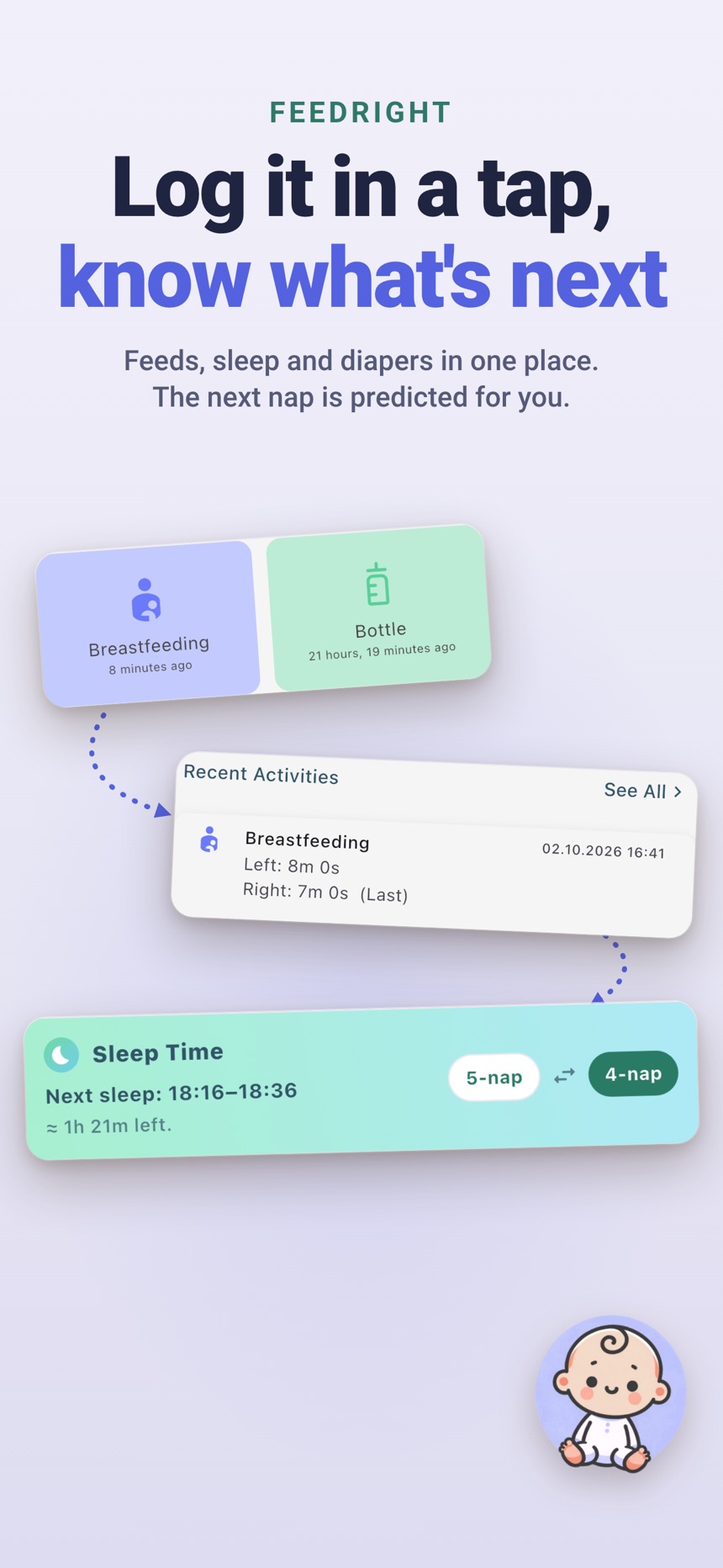
- Run a live sleep timer for each nap and end it from the iPhone Lock Screen.
- See an estimate of when the next nap is due, shown from 3 months of age.
- Review the daily summary, or full 7 and 28 day statistics with FeedRight Premium.
Some days will still go sideways. The nap may happen in the car, on your shoulder, or 90 minutes later than planned. Take the information you can from the day, offer the next sleep opportunity with a little calm, and remember that routines are built one nap time at a time.
Frequently asked questions
How many naps does a baby need in the first year?
It varies, but many babies take three or four naps around 3 to 6 months, two or three around 6 to 9 months, and two by 9 to 12 months. Newborns nap many times in irregular pieces. Your pediatrician can tell you what fits your baby.
Are 30-minute naps normal?
Short naps are common, especially between about 3 and 6 months while sleep cycles mature. If your baby wakes happy, feeds well and sleeps reasonably at night, a short nap may just be their normal for now.
Should I wake my baby from a long nap?
Some parents shorten a very long late-afternoon nap so bedtime is not pushed too late. For newborns and babies with feeding or weight concerns, ask your pediatrician whether you should wake them for feeds.
When do babies drop to two naps?
Many babies move from three naps to two somewhere between about 6 and 9 months, as the late-afternoon catnap fades. An earlier bedtime for a few days can help while your baby adjusts.
How long should a baby be awake between naps?
Awake time between naps grows with age, from about 45 to 90 minutes in the newborn weeks to a few hours by the end of the first year. Use these as loose guides alongside your baby’s tired cues.
How much daytime sleep does a baby need?
Daytime sleep varies a lot: around 3 to 6 months it may total about 3 to 5 hours, and by 9 to 12 months it commonly lands around 2 to 3 hours. Your baby’s mood, feeding and night sleep matter more than hitting a number.